Kung Fu and lycanthropy: an irresistible combination if you ask me, and this fun Sonny Chiba movie proves it! Adapted from a popular manga, 1975’s WOLFGUY: ENRAGED LYCANTHROPE (URUFU GAI: MOERO OKAMI-OTOKO) was one of several dozen 1970s starring vehicles for JJ Shin’ichi “Sonny” Chiba, Japan’s answer to Bruce Lee, who’d shot to stardom a year earlier in the phenomenally popular STREETFIGHTER and its sequels.
WOLFGUY, a quasi follow-up to the 1973 film HORROR OF THE WOLF, is certainly one of the most unique and interesting of Chiba’s 100-plus films, yet also, curiously enough, one of the most obscure. For decades it was presumed lost, and remains tragically little known.
A man freaks out in the middle of a crowded city street, screaming about seeing a tiger, and inexplicably dies, with his body bearing what look like tiger claw scratches. This sordid spectacle is witnessed by Inugami, a cop afflicted with horrific memories triggered by the assault.
Inugami is investigating the case of Miki, a popular singer who was gang raped and injected with syphilis. The assault was apparently ordered by Manabe Productions, the yakuza-riddled company for which Miki worked. Inugami tracks her to a nightclub where she’s performing, and from there she leads him back to her lair, where he takes out several of her yakuza tormentors by pelting them with coins. In the melee one of the yakuza undergoes a freak-out much like the one that occurred in the beginning, spasming and screaming about a tiger, and bleeding all over from seeming tiger claw wounds.
Inugami shacks up with Miki, and in the process discovers more about her. It seems she was killed by her tormentors, only to be brought back to life—in which guise she cursed the scumbags to be attacked by a spectral tiger.
This inspires Inugami to think back to how as a child his mother informed him that on the 15th day of every lunar cycle he’ll transform into a werewolf. He’s the last member of the Inugami blood line, with his relatives having all been massacred.
But then the Manabe lackeys capture Inugami and subject him to horrific surgical experiments. These include a blood transfusion in which one of the gang’s minions is given werewolf DNA.
Not that any of this matters, as the 15th day of the lunar cycle is at hand, and Inugami transforms—not into a wolf, but a more souped-up version of himself that can leap impossible distances and reverse the surgical injuries done to him. In this state Inugami breaks out of the bad guys’ compound and fights his wolf blood-transfused nemesis–the latter dies, however, due to the fact that human and werewolf blood apparently don’t mix.
Inugami decides to head back to the forest stronghold where his family originated. There he gets involved in yet more fights, and meets a hot chick who provides sex (of course), and also some vital information about Inugami’s unique heritage.
For what it is WOLFGUY: ENRAGED LYCANTHROPE works: it’s lean, unpretentious and ultimately (despite a rather abrupt ending) quite satisfying. It contains a great deal of nastiness, with the spectral tiger attack motif allowing for a lot of spurting blood. There are also plenty of kung fu fights, enhanced, as was the case with most martial arts films of the seventies, by outrageously over-modulated whishing and thwacking sound effects. There are also copious explosions and a great deal of gunplay in the final scenes, evincing a definite Sam Peckinpah influence.
The film is further marked by an outrageous funkadelic score, as well as the inevitable overuse of the zoom lens, outré camera angles and rudimentary psychedelic effects that mark it out as a quintessential product of its time. Yet it contains some genuinely wild and unexpected sights, such as that of Inugami’s exposed innards sliding back into his open stomach cavity, which then seals itself shut.
As for Sonny Chiba, he essentially essays the same role he did in better-known seventies programmers like THE STREET FIGHTER and THE BODYGUARD: that of a stoic and largely personality-free tough guy who never comes up short in a fight. The fact that he plays a lycanthrope here only enhances his particular talents. --The Bedlam Files
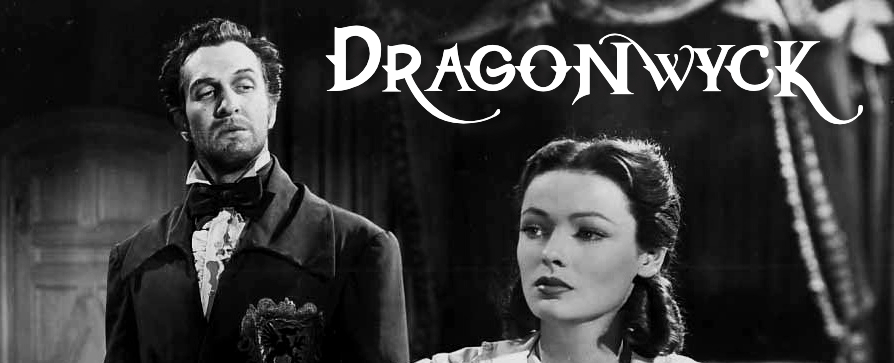
Joseph L. Mankiewicz’s first feature film, from 1946, is a gothic romance, set in upstate New York in the eighteen-forties. With its blend of historically accurate political debates and macabre mysteries, it plays like a blend of Poe and Tocqueville. The story concerns young Miranda Wells (Gene Tierney), a pious Yankee farmer’s daughter, who enters service as a nanny in the lavish (and haunted) Hudson Valley mansion of Nicholas Van Ryn (Vincent Price). But Van Ryn has designs on the young woman and plans to marry her—once he disposes of his wife. As “patroons” (descendants of the region’s original Dutch settlers), Van Ryn and his wealthy peers ludicrously re-create European court culture—and feudal dominion—in the foothills of the Catskills, but the local farmers rebel. Mankiewicz builds the drama around real-life events in New York State’s violent Anti-Rent War, including a famous murder trial, the election of Governor John Young on a land-reform platform, and a doctor (played by Glenn Langan) who leads the strikers. Mankiewicz’s incisive visual prose deftly parses the characters’ political psychology along with the lurid romance; he reserves his most poetic flourishes for the whirling dance that snares Miranda in Van Ryn’s web of intrigue. --The New Yorker
To make a silent film in 1931, four years after The Jazz Singer, was to buck the trend in a film industry rapidly divesting itself of silence. To make another in 1936, nearly a decade after the advent of sound, appeared downright perverse. Charlie Chaplin had once been the paramount icon of modernity, rushing headlong across the screen in a dazzling imitation of the speed and grace of contemporary life. In clinging stubbornly to silence with City Lights, and then (mostly) with Modern Times, however, he was risking seeming, of all things, passé. For audiences accustomed to the rapid-fire patter of the Marx Brothers, W. C. Fields, and Mae West, Chaplin’s refusal was stretching the limits of their dedication to the Little Tramp—Modern Times, especially, suffered at the box office. And yet, when accounts are tallied of Chaplin’s greatest works—the foremost films of the foremost performer in the history of American film—these two era-straddling anomalies are often at the top.
Chaplin once told fellow filmmaker Jean Cocteau that a film was like a tree: when shaken, it shed everything loose and unnecessary, leaving only its essential form. For the man who had created the most beloved film character of all time, spoken dialogue was merely a decorative leaf distracting attention from the sturdy oak of performance. Twirling his cane, tipping his hat with delightful delicacy to a generation of moviegoers, Chaplin’s Tramp had needed no words to communicate. “For years, I have specialized in one type of comedy—strictly pantomime,” Chaplin observed in 1931, the year of City Lights. “I have measured it, gauged it, studied. I have been able to establish exact principles to govern its reactions on audiences. It has a certain pace and tempo. Dialogue, to my way of thinking, always slows action, because action must wait on words.”
Chaplin was afraid of losing what had made him so remarkable by embracing sound, but he also feared irrelevance. “I was obsessed by a depressing fear of being old-fashioned,” he said of his hiatus from filmmaking after City Lights. But how could he modernize without erasing what was unique about him? This was the problem posed and, for the moment, solved by Modern Times. “I forget the words,” the Tramp pantomimes to his love (played by Paulette Goddard), referring to a song, and what is true of the character was true of the artist as well. For the film is not silent, precisely; it is merely without dialogue, while featuring music, sound effects, and a climactic bit of Chaplin’s own singsong gibberish (about which more shortly). It is a recapitulation of his earlier work, the director taking a triumphant final lap around the style he did so much to invent, before reluctantly turning to the new challenges of sound. In it, the Tramp bows one last time to the audience that has loved him so much, before disappearing forever.
We think of Chaplin as such a product of the twentieth century—its technological prowess, its speed, its ready commodification—that it is easy to forget that the man himself was a child of the nineteenth century, born in London in 1889. Chaplin’s childhood was brief, cut short by the tragedies of losing his father to alcoholism-induced dropsy and his mother to the ravages of mental illness. Charlie spent much of his youth in dreary workhouses, interrupted by brief stints with relatives, before setting out on his own at the age of fourteen.
The young Chaplin wheedled his way into a temporary position with Fred Karno’s vaudeville company in 1908. Karno had hired Chaplin’s half brother and protector Sydney two years earlier but soon discovered that it was undoubtedly Charlie who was the star of the family, as he would be of the company. The Karno players toured incessantly, and on one American jaunt, Chaplin was summoned to an attorney’s office for a meeting. He assumed that he was to receive a bequest from a relative, but what was on offer was far more significant: a contract to join Mack Sennett’s Keystone film company in Los Angeles, at $150 a week.
The elements came together rapidly. The costume—too-large pants, too-small jacket, little hat, and big shoes—was grabbed out of Keystone’s wardrobe closet for an early short. The duck-footed waddle was borrowed from a figure Chaplin remembered from his London childhood. The raucous mayhem was the trademark of Sennett, creator of the Keystone Kops, but the jaunty tone of exuberant politesse—the tipped hat and twirled cane—was Chaplin’s own.
Chaplin’s early years in Hollywood were a remarkable blur of improvisatory brilliance and astounding artistic growth. Sennett was an ideal mentor, but Chaplin rapidly outgrew the roughhousing, looking beyond slapstick to something subtler. Shorts like The Rink (1916), One A.M. (1916), and The Immigrant (1917) are perhaps the finest examples of his virtuosic physical gifts, of the unexpected reversals and inversions at the heart of his humor, and of his deft sentimental touch. The Tramp is heroic, and heroically self-serving, and his manipulations of the physical world are magnificently cunning. The films’ plots are the artificial limits placed on Chaplin’s seemingly limitless ingenuity, the net that turns anarchy into a civilized game of tennis.
Chaplin argued, during his one- and two-reel reign in the 1910s, that comedies, by their nature, should be no longer than they already were—that the requirements of the feature film would inevitably distort the charms of the form. The director had, though, been subtly shifting the concept of what a Tramp short could be; the nakedly emotional Easy Street (1917), for example, was hardly the stuff of Keystone comedy. Restless as he was, Chaplin soon saw that he had conquered the ten-to-twenty-minute format. He could go on indefinitely producing variations on 1916’s The Pawnshop (and there are those who claim, not unreasonably, that that was what he did best), but he preferred the uncertainty of a fresh challenge. The emotional tug of late Chaplin shorts like The Immigrant demanded a broader canvas.
Chaplin’s feature-length films are not merely extensions of his shorts; they are translations of his comic technique into a more flexible, emotive form. The shorts are brilliant, but they primarily document the brilliance of the performer; the features allow Chaplin to vary the emotional palette of his work and to engage his skill as a filmmaker. The shorts had made Chaplin a star, but the features made him an artist. The Tramp is no longer just a miraculously energetic scamp but also a fragile soul wounded by a cruel, uncaring world. Chaplin features like The Kid (1921), The Gold Rush (1925), and City Lights (1931) are hardly less astonishingly amusing than his shorts, but they add a dimension of feeling heretofore lacking in his work. Chaplin was adamant that the Tramp would never speak, and given the indubitable genius of his performances in The Gold Rush and City Lights, one sees his point. Modern Times would be the Tramp’s last run.
In his review of Modern Times for the New Republic, Otis Ferguson argued that the film could best be understood as a return to Chaplin’s roots: “It is a feature picture made up of several one- or two-reel shorts, proposed titles being The Shop, The Jailbird, The Watchman, and The Singing Waiter.” And indeed, the film does divide neatly into four segments, of which the one Ferguson dubbed The Shop—wherein the Tramp is seen working the assembly line until he becomes the assembly line—is easily the most memorable, and remembered. (One could argue that all of Jacques Tati’s work springs from this segment of Modern Times.) The structure of the film, that is, reflects a certain nostalgia for Chaplin’s past glories.
But Modern Times also points to a new phase in Chaplin’s life and thinking, to changes in his outlook, personal as well as aesthetic. The film marks the first time that his private political awakening—his most costly transformation, born of his experiences of the previous decade—appears tangibly on the screen. Later, he would be accused of being a communist, but the film’s political symbols (a humbled worker here, what appears to be a red flag there) are mostly subsumed by the humor. Overall, Chaplin seems to be drawing a connection between his awareness of the Tramp’s obsolescence—and, potentially, his own—and fears about the mechanization of modern life and its potential for crushing the common man, whom the Tramp has come to symbolize. His apprehensions are writ large in Modern Times, transmuted from a lone filmmaker to all of humanity: it is the machine that is mankind’s true opponent, deadening the senses and twisting flesh into steel.
Chaplin is in earnest about his concerns, but he successfully translates them into the stuff of superlative comedy. To see the Tramp strapped into an auto-feeding machine, being shoveled a steady diet of metal nuts, or emerging from a shift on the factory line still adjusting phantom screws (even attempting to tighten the buttons on a woman’s dress), is to witness Chaplin’s alchemical gift for transforming anxiety into humor. The Tramp is menaced by technology, and while Chaplin’s revenge is only partial and symbolic, it is essential nonetheless.
Chaplin pits the Tramp’s superhuman improvisational abilities against a soulless mechanical sphere that, he believes, is the negation of our collective humanity. Witness the brilliant scene where the Tramp must feed lunch to his coworker, stuck inside the gears of an enormous machine. Charlie uses a chicken as a funnel to pour hot coffee into his recumbent friend’s mouth. Chaplin is, in essence, placing his own genius in competition with modernity, asking audiences to root for his inventive brilliance over the unthinking dutifulness of the machine.
In Paulette Goddard, with whom he was romantically linked at the time, Chaplin finds his ideal female lead. Modern Times is not his most romantic work—that title unquestionably belongs to City Lights—but after years of limited female costars, Chaplin finally had one whose zest, charm, and energy approximated his own. Their characters’ romance is a painful one, as all of Chaplin’s screen entanglements are, but he grants Goddard the rare privilege of walking off into the distance with him at the film’s end, two wanderers content with the open road—and each other.
Modern Times is actually, secretly, an origin story for the Tramp, just in time for his farewell. When Charlie is hired as a singing waiter and belts out a charming gibberish song composed of jumbled, faux-Italian syllables—Chaplin’s virgin attempt at producing sound, if not speech, on-screen—we are witnessing the birth of an entertainer. All that has passed is mere prologue. But the singing Tramp would not go on.
After Modern Times, Chaplin grew increasingly serious about politics, specifically the threat of fascism. And with the rise of Adolf Hitler and the onset of World War II, he became more outspoken, addressing a war rally in San Francisco on the urgency of Russian war relief, referring to the crowd as “comrades.” What seemed like innocuous patriotic fervor during the war took on, for some, a disturbing red tinge afterward, and fervent anticommunists sought to tar Chaplin as a Soviet fellow traveler. In 1952, as Charlie, his wife, Oona, and their four children traveled by boat to London for the premiere of Limelight, word came by radio that U.S. attorney general James McGranery had invalidated Chaplin’s reentry permit, calling for the INS to hold hearings on his fitness to reside in the country. McGranery hinted at secret documentation that would reveal much about the actor and director’s “unsavory character.” Chaplin and his family resettled in Switzerland. He would not set foot in the United States for another twenty years—when, more than four decades after the Academy had first presented him with an honorary award, for The Circus (1928), he was summoned back from exile to receive a lifetime achievement Oscar.
Whether because of changing political or aesthetic winds, Chaplin’s films after Modern Times never received the universal acclaim of his earlier work. The Great Dictator (1940), which viciously parodied Hitler, was well-liked though criticized by many for preachiness, and later Chaplin efforts like Monsieur Verdoux (1947), Limelight, and A King in New York (1957)—as bitter as they were sweet—were battered by critics, who found them dogmatic.
The unique triumph of Modern Times is that it maintains the playful aura of the early Tramp and the comedic sophistication of The Gold Rush and City Lights, all while carefully balancing the humor with sentiment, charm with political awareness. It is Chaplin before life, and the world of which he was an ever more careful observer, began to weigh him down. With it, he bid a fond farewell to the silent film, and to the character who had made him the most famous man in the world. For Chaplin, it was the end of an era. But for fans of the greatest talent ever to grace the American screen, that era can be retrieved merely by cuing up Modern Times once more. --Criterion
Toshio Matsumoto’s 1969 film Funeral Parade of Roses is a heady affair, especially when seen in our aesthetically and politically conservative times. It imparts the thrill of witnessing the hedonism and lawlessness—both sexual and artistic—of a bygone culture. You also feel an almost tragic surge of melancholia watching it: where and when, you wonder, will cinema ever get quite this wild again?
According to various online sources, Stanley Kubrick acknowledged Matsumoto’s film as an inspiration for A Clockwork Orange, although I haven’t found any concrete evidence for where or when he might have done so—and it’s hard to see exactly what he might have taken from Funeral Parade of Roses, other than a heavy use of wide-angle lenses and a general celebration of in-your-face provocation. Certainly, nothing in Kubrick’s work is remotely as queer as any given moment in Matsumoto’s feature.
Without giving too much away, Funeral Parade of Roses is partly a loose modern queer rewrite of the Oedipus myth, although how and why it is doesn’t fully become clear until the end—when we witness the supremely paradoxical use of a subjective shot depicting the point of view, as it were, of an Oedipus figure who has just gouged out both his eyes. For the most part, however, Funeral Parade comes across as a free-form evocation of an unofficial coalition between two outsider communities in Tokyo: on one side, cross-dressers and other young gay men (the Japanese term being geiboi), and on the other, avant-garde artists.
The film’s protagonist, at the center of a sort of Shinjuku demimonde reworking of All About Eve, is Eddie, a young transvestite nightclub hostess who is having an affair with the ostensibly straight, or at least straight-acting, club owner Gonda. Eddie is played by Peter, a singer and dancer whom you’ll know as the androgynous Fool character in Kurosawa’s 1985 King Lear adaptation Ran. Peter’s Eddie is drag star as ’60s It Girl, a baby-faced creature with big moon eyes under a blonde mop—Shinjuku’s own Edie Sedgwick. Peter charges the role with flirtatious wit and extreme sensuality—as witness the display of luxurious eye-rolling in a nude shower scene. As for Gonda, he is played by square-jawed, sports-jacketed Yoshio Tsuchiya, a mainstream and genre stalwart known for roles in various Kurosawa films including Seven Samurai and Throne of Blood—as well as Destroy All Monsters.
Gonda’s patronage will put Eddie in prime position to be the new madam of the Genet club, where middle-aged salarymen can make out with lissome cross-dressers; the Genet is currently ruled by the older Leda (Osamu Ogasawara), whose more traditional geisha guise contrasts with the go-go-girl look rocked by Eddie. The latter’s poisonous entanglement with Gonda and Leda itself makes for an Oedipal family schema, but the story also involves a more literal version of the triangle—the central mystery that the film’s jigsaw construction of repetitions and ellipses slowly circles in on, before getting to the nub of it in a violent flashback that is followed by an even more brutal pay-off revelation.
The other strand of the film involves an evocation of the artistic wild life of the late-’60s Shinjuku district. Eddie and his friends spend a lot of time hanging out with a group of hippie-ish marginals—a coalition of rebel subcultures that’s very Warholian. The artists’ group is led by young filmmaker Guevara (Toyosaburo Uchiyama), so named for his bushy mustache—which are revealed, in this pageant of self-exposing illusion and play-acting, to be as fake, as much a drag act, as anything else seen here. Guevara and company are making a film of some sort (it involves filming blurry, distorted TV coverage of student protests), and generally hanging out in a room, under the approving eyes of a Beatles poster, where they enjoy very late-’60s free-form freakouts. A stoned evening involves dancing wildly to fuzz-guitar jams (echoes of the Yardbirds in Antonioni’s Blow-Up), then a parlor game in which whoever can’t walk a straight line gets stripped by everyone else. This sequence goes on a long time, but everyone, actors and characters alike, seems to be having a groovy, guilt-free time—which is what makes the punitive Greek tragedy climax all the more unsettling.
Formally, Funeral Parade is an unpredictable, risk-drunk affair, mixing fiction (both quasi-realism and melodrama fabulism) with a deconstructive documentary edge, plus a carefree ludic goofiness that’s part Godard, part Three Stooges. Matsumoto and editor Toshie Iwasa undermine the narrative by dropping in interviews with various geiboi and stoners on their lifestyles—as well as one with Peter, who plays Eddie, on the very film we’re watching. A no-holds scene of anal sex between Eddie and an African-American john turns out to be only a matter of simulation—the lover is seen reclining at the opposite end of the bed to Eddie, with a crew headed by Matsumoto himself filming Peter’s solo exertions. Other interruptions include a flash insert of a warning from the Japanese board of film classification, plus—after the drama’s most emotionally extreme moment—a cut to an affable TV host inviting us to come back and enjoy another movie next week.
Elsewhere, the eventual confrontation between Eddie and Leda—flagged up in advance as the film’s dramatic boiling point—is played out as first a mock Western showdown with toy guns, then a duel of comic-strip word balloons, then as a farcically speeded-up catfight. Less playfully, the film is also laced with an array of quotes and slogans, both on and off screen: captions including (as they’re translated here) “What a Subtle and Mysterious Scheme,” “Oh The Empire of Roses,” and “The World Is About To End,” plus references to, among others, Jonas Mekas and French novelist J.M.G. Le Clézio.
There’s also a lot of street performance on show, largely the contribution of theater group Zero Jigen (Zero Dimension), known for their public interventions and more private orgiastic displays. Matsumoto believes in taking his spectacle to the streets—as in a scene in which Eddie and two friends rumble with three tough girls (members of a sukeban, or girl gang) in a shopping precinct, to the bewilderment of bystanders.
Funeral Parade was the first feature of Matsumoto, who had previously, for over a decade, made documentary and experimental shorts, and worked as part of interdisciplinary group Jikken-Kobo (Experimental Workshop)—one of whose members, the great composer Toru Takemitsu, collaborated on his films. The composer of Funeral Parade, also an eminent mainstay of Jikken-Kobo, is Joji Yuasa. His eerie electronic compositions set the tone at the start, as a setting for bleached-out close-ups of Eddie’s and Gonda’s love-making—this opening sequence surely a prime exhibit piece for an anthology of erotic modernism. The black-and-white photography by Tatsuo Suzuki (whose credits also include work with Shuji Terayama) throws in a wild array of textures and looks—including flash inserts of bleached-out photocopy stills, and a range of wide-angle interiors, both delirious and claustrophobic.
Funeral Parade of Roses is an extraordinary film for its energies, its libidinous intensity, and its fearlessness in mixing registers—high melodrama, violent intensity, farcicality, and poetic seriousness—all against a background of late-’60s aesthetic revolt and political unrest (notably the student protests against U.S. military presence in Japan during the Vietnam War). Film history celebrates this period’s experimentation by directors such as Terayama, Oshima, and Imamura—but Funeral Parade, no doubt because of its out-and-out queerness, has remained something of a film maudit. Its time has come again in this new 4K restoration. At one point, one of Guevara’s gang declares, “All definitions of cinema have been erased. All the doors are now open,” then tells us whom he’s quoting—Mekas. Whether or not Funeral Parade of Roses erases all definitions of cinema, it certainly blurs them with phenomenal erotic and political gusto. It also makes you realize just how many of the doors have closed again—and pretty much stayed closed—since those days of boundless possibility. --Film Comment
“It’s sad to say, but women do not have much importance in westerns,” observed Anthony Mann, a master of the genre, in a 1957 Cahiers du cinéma interview. Made that same year, Samuel Fuller’s Forty Guns begins with a whopper of a scene that tells a different story. A small wagon plods across a vast landscape, still and quiet save for the rolling clouds and chirping birds. “Whoa!” calls the man holding the wagon reins, as a thunderous sea of hooves appears. Forty horsemen advance over a ridge at full gallop, led by a woman dressed in black astride a white stallion. Her riders rapidly bear down on the wagon like a lion on its prey, splitting to form a moving gauntlet on either side. The scene cuts between high- and low-angle shots as the men in the wagon cower from the dust and the harnessed horses rear, trapped and squealing, their vulnerability amplified by the visceral construction of space and contrapuntal sound. Then the woman and her forty guns are gone, as fast as they arrived. The men in the wagon gaze at the receding dust trail in shock. “That was no ordinary woman,” they seem to be thinking. And we realize: this will be no ordinary western.
Over the course of more than fifty years, Samuel Fuller surprised and provoked audiences with boldly original, convention-bashing films rooted in action-oriented genres. Already an accomplished journalist, novelist, and screenwriter and a decorated World War II infantryman by the time he began directing in 1949, Fuller cut his filmmaking teeth at Lippert Productions in the world of B movies, learning how to exploit limited resources to produce the maximum punch. The hard-hitting realism and outsize success of his Korean War film The Steel Helmet (1951) earned him a contract with Twentieth Century-Fox in the waning days of the studio system. Fuller got along well with Fox’s production chief, Darryl Zanuck, and directed such standout features as the seminal film noir Pickup on South Street (1953) and the visually sublime policier House of Bamboo (1955), but by 1956 he had eagerly left the studio in search of greater creative freedom.
Forty Guns is one of six sensationalistic pictures Fuller subsequently completed through his independent production company, Globe Enterprises, between 1956 and 1961. The Globe years saw Fuller flinging off the corset of quality controls that had shaped his studio releases, embracing more loosely constructed plots, offbeat humor, jarring tonal shifts, and frequently daring content. Financed and distributed by Fox for $429,000—far less than Fuller’s typical outlay when he was under contract at the studio—Forty Guns was produced independently on Fox’s back lot and released at both the top and bottom half of double bills. The picture received positive reviews for its solid cast and fast-paced action but was not a box-office performer. Today, however, we recognize it as Fuller’s most entertaining and audacious assault on classical and generic conventions up to this point in his career—loopy, jarring, and, more than once, jaw-dropping. There’s even a tornado!
At the center of the film are the two main figures from the opening scene: the Wyatt Earp–like federal marshal at the reins of the wagon, Griff Bonell (Barry Sullivan), and the “high-riding woman with a whip,” Jessica Drummond (Barbara Stanwyck). Griff arrives in Tombstone with his younger brothers, Wes (Gene Barry) and Chico (Robert Dix), to deliver a warrant. They find their suspect under the employ of Jessica, a land baroness and the boss of Cochise County, who is weighed down by a younger brother of her own, the unhinged Brockie (John Ericson). A renowned lawman who has forsworn gunplay because he “can’t miss,” Griff hesitates to get involved in local matters but finds himself drawn to Jessica. Jessica is attracted to Griff’s confidence and capability—they mirror her own—but wants him to work for her. The pair’s romantic and familial loyalties come into seemingly insurmountable conflict when Brockie kills Wes on his wedding day, leading to a final showdown where Griff shoots through Jessica to kill Brockie.
While the story sounds rather tidy in summary, the plot of Forty Guns is rife with intrigue and action—juggling political corruption, theft, betrayal, an unwanted pregnancy, a serious maiming, three romances, four murders, and a suicide. Fuller had first submitted the screenplay in 1953, during his tenure at Fox, but Zanuck had found it excessive, unfocused, and overly violent, with too many subplots and villains detracting attention from the central love affair and the two sets of sibling relationships. In script notes, Zanuck zeroed in on the character of the “strong woman who runs the empire” as especially unconvincing: “It becomes too extreme when you develop the size of her dynasty and furthermore when you involve her in a dictatorship control not only over her own ranch but over the politicians and townspeople and everything else. This is just too much to swallow.” Yet Fuller largely retained the plot elements Zanuck found too unruly when revising the script for the Globe production, an illustration of how he used his creative control as an independent producer to expand the boundaries of convention—particularly those having to do with genre and gender.
The most playful way in which Forty Guns engages with genre is through campy double entendres that self-consciously exaggerate metaphors rooted in western iconography. Jessica berates Brockie for beating his pregnant girlfriend, snapping, “If you can’t handle a horse without spurs, you have no business riding,” while she later tells Griff about a cabin, “I was bitten by a rattler in there when I was fifteen.” He replies dryly, “Bet that rattler died.” As Wes develops an attraction to Louvenia (Eve Brent), the gunsmith’s daughter, he tells his brothers: “She’s built like a .40-40. I’d like to stick around long enough to clean her rifle.” After Wes and Louvenia kiss for the first time, she asks, “Any recoil?” (Their kiss dissolves from a shot, from Wes’s point of view, of Louvenia through the barrel of a rifle, a sexually suggestive ellipsis reworked as an homage by Jean-Luc Godard in Breathless three years later.) An even more explicit exchange occurs after Jessica asks Griff to replace her right-hand man: “I’m not interested in you, Mr. Bonnell. It’s your trademark. May I feel it?” When she reaches out her hand for his gun, Griff shakes his head, “Uh-uh.” “Just curious,” she innocently replies. He warns her: “It might go off in your face.” Along with the two communal bathing scenes (a Fuller thing), such exchanges provide unexpected moments of comedy within an otherwise dramatic narrative.
Fuller’s experimentation also extends into the realm of style, as he visually deconstructs three conventional western scenes: the showdown, the marriage, and the funeral. Griff’s initial confrontation with Brockie, after the latter shoots the local marshal in the leg, is not a classic showdown, won by the man who draws first and shoots straight. Instead, as Griff boldly strides toward the out-of-control Brockie, a rhythmic progression of shots builds, intercutting the approaching lawman’s legs, face, eyes, and point of view. The repetition of images develops suspense, while the percussive score and extreme changes in scale create an element of hysteria. Finally, Griff comes face-to-face with Brockie and pistol-whips the bewildered lad—a showdown won without a shot fired.
The presentation of Wes and Louvenia’s wedding is similarly daring, as Fuller turns the celebration into a prologue to the funeral. The nuptials themselves are not seen—only the couple’s joyful emergence from the church. Then a shot rings out while the families pose for a picture. Images of Wes and Louvenia are rapidly juxtaposed as they collapse to the ground. The bride lies trapped beneath her dead husband, crying like a wounded animal: “Wes! Wes!” The high-spirited, flirty young couple are married for all of thirty seconds—the end of which is about as extreme a tonal shift as we see charted in Fuller’s work. A slow dissolve then segues into Wes’s funeral. Typically, western funerals emphasize communal grief and the vulnerability of settlers on the untamed frontier. In Forty Guns, the three-shot scene reduces the ritual to its barest iconography: the widow, the hearse, and the act of mourning, here depicted through the town balladeer, Barney (Jidge Carroll), singing “God Has His Arms Around Me.” While Fuller’s Run of the Arrow (also 1957) respectfully engaged the tropes of the cavalry-and-Indian western while expanding their thematic application, Forty Guns utterly transforms its genre in startlingly novel ways.
Equally memorable is the character of Jessica Drummond, as written by Fuller and performed by Stanwyck, a sharp contrast to the typical helpmate or moral-conscience role fulfilled by most female protagonists in westerns. Fuller consistently worked tough, strong-minded women into his pictures—whether as supporting characters, such as Thelma Ritter’s streetwise Moe in Pickup on South Street, or as protagonists second to no man, such as Angie Dickinson’s canny smuggler Lucky Legs in China Gate (1957)—and from the very opening of the film, Jessica’s dominion over men is on display. When Griff goes to her house to deliver the warrant for her hired hand, the camera follows the paper as it is passed down the table, the length of the shot (and of the table) a visual illustration of the sheer number of men Jessica commands—not just the forty guns but also the politicians, judges, and marshal who are present. As Jessica and Griff languidly make love after the melodramatic appearance of the tornado, she tells him, “I need a strong man to carry out my orders.” “And a weak man to take them,” he replies, the deep shadows of Joseph Biroc’s high-contrast photography crisscrossing their bodies and spelling doom. Sullivan and Stanwyck clearly have fun with Fuller’s dialogue, their easy flirtation a reminder that they had shared the screen just a year before in Republic’s The Maverick Queen, also playing characters on opposite sides of the law. Stanwyck’s tough-cookie persona and a string of earlier turns as fierce women in westerns—The Furies (1950), Cattle Queen of Montana (1954), and The Maverick Queen among them—made her a natural fit for the part, but she gives this character subtle shading throughout, bringing not only determination and anger but also real desire, tenderness, and remorse to the role. Stanwyck did all her own riding and stunts for the film, including three takes of the vividly staged tornado sequence, in which she is dragged behind her horse. Fuller was quite impressed by her dedication, describing her as “a helluva gal” in his autobiography.
The thrilling appeal of a woman in command of a western empire is partially undercut by the film’s ending, however, a compromise Fuller would come to regret. After Griff wounds Jessica in order to kill Brockie, he assumes she will no longer love him. “You have to be big to forgive,” he observes. But the final scene finds a white-gowned and wounded Jessica running after Griff’s wagon as he leaves town, with Carroll crooning the film’s theme song: “But if someone could break her / And take her whip away / Someone big, someone strong, someone tall / You may find that the woman with a whip / Is only a woman after all.” Shorn of the land, money, and influence she used to try to secure freedom for herself and Brockie, and without the markers of prestige—the forty guns, white stallion, and black riding gear—that distinguish her throughout the film, Jessica retains only abstracted and feminized signifiers of power: she is strong because she can forgive and love. The ending’s affirmation of traditional gender roles does nothing to erase the rest of the film’s audacity, yet Fuller recognized it as unsatisfying. In later interviews and his autobiography, he suggested that he wanted to conclude the film with Griff shooting both Brockie and Jessica dead, then throwing away his gun in disgust; it was Fox’s marketing department, he claimed, that insisted a picture where the hero killed the heroine would never sell. Though both Fuller’s original script and the draft he used to produce Forty Guns contain the final scenes as shot, it is perfectly plausible that he received pressure from executives to create a more conventional conclusion. Regardless, Andrew Sarris reported that Fuller later so strongly preferred the alternate ending that he once publicly screened the film without the reconciliation of Jessica and Griff—his own version of a director’s cut. Can you imagine what it must have been like that night to see the film end with Griff killing the woman he loved in order to murder her brother? The finale would have been utterly unexpected, a little nuts, astonishing—and thus completely Fuller. --Criterion
August 8, 2007 saw a huge celebration in Beijing marking the one-year countdown to the opening of the 2008 Beijing Olympics. The accompanying mass rally in Tiananmen Square, with its climax of fireworks and pop singer performances, is the modern face of a transformed China that its Communist-in-name-only government wants to project to the world. Somehow I can’t imagine Jia Zhang-ke paying much attention to these antics — just think back to his Unknown Pleasures (2002), where we see his two loser heroes Bin Bin (Zhao Weiwei) and Xiao Ji (Wu Qiong) profoundly indifferent to the noisy celebrations over the awarding of the Games to Beijing. Jia’s films are as far from celebrations of contemporary China’s modernisation as it is possible to be — his concerns are with those Chinese forced to the margins or left behind by his nation’s social and economic changes. It was a point made perhaps rather too obviously in The World (2005), where the protagonists are limited to an imitation theme-park world, an inauthentic simulacrum of the icons of the globalised world that they can never gain access to.
Still Life (2006) marks a substantial advance on The World. This is not only in the way Jia has deepened his themes and characterisations — once again, his concerns are with individuals whose lives are disrupted and displaced by ongoing societal changes, but for the first time his central characters are older, more mature. They’re people whose pasts have a direct bearing on their actions in the present, unlike in the earlier films where the characters are almost blank slates come into being as the film commences, focused on the here and now, with no reference to a past before the start of the story. Also, Still Life‘s two protagonists, Sanming (Han Sanming) and Shen Hong (Zhao Tao), are better survivors, more tenacious, and their fates have none of the sense of failure, of coming to a dead end, that marks Jia’s other films. Yet the success of Still Life rests not only on the fruitful variations Jia has brought to his customary themes and characters, but, equally and as importantly, on the tremendous mastery of form evident throughout the film. Working with his constant cinematographer Yu Lik-wai in high-definition digital video, Jia has made a film that is as beautiful and as deeply felt as any you are likely to see nowadays, the work of one of the foremost directors working anywhere in the world today.
The inspiration for Still Life lies in documentary — first, a documentary directed by Li Yifan and Yan Yu, Before the Flood (2005), which Jia saw as president of the jury of the Cinéma du Réel documentary festival in March 2005; then Jia’s own documentary Dong (2006). Before the Flood is a Direct Cinema-style observational film of the inhabitants of the city of Fengjie (the setting for Still Life) as they dismantle their lives physically and emotionally before their homes are flooded in the Three Gorges Dam project. This is, of course, modern China’s major development project: the world’s largest hydroelectric dam, twelve years in construction (1994-2006) and due to start power generation in 2009. But the project also entails massive flooding, including inundation of the famous Three Gorges (a tourist site with strong cultural associations for the Chinese), and the resettlement of up to 1.9 million people.
A lot of Before the Flood‘s concerns seem to have fed into Still Life. There’s the general sympathy for the plight of ordinary people whose homes, livelihoods, and networks of relationships are being eradicated. In addition, Before the Flood‘s frequent scenes depicting the indifference of government officials and Communist Party cadres to the sufferings of the general public affected by the dam project have been replicated by Jia in Still Life in two carefully balanced scenes, each witnessed by one of the film’s main protagonists: Sanming in the Relocation Office, Shen Hong in a shut-down state factory. (There’s also a striking related scene where a government official orders the lights of a new bridge turned on for the benefit of his guests.)
Dong is the film that Jia started shooting when he first went to Fengjie. It’s a portrayal of his friend, the artist Liu Xiaodong, and how he works on large-scale paintings of male demolition workers in Fengjie and then of female bar workers in Bangkok. (The “Dong” of the title, more than drawing significance from its meaning of “East,” references one of the characters in Liu’s personal name.) Jia went to Fengjie in September 2005 on Liu’s invitation and it seems right to assume that he was specifically interested in going there from his knowledge of Li and Yan’s documentary. A week after starting on Dong, Jia decided to make Still Life, from then on shooting the two films in parallel. In fact, the films share some of the same footage, including non professional actor Han Sanming (Jia’s cousin, who has appeared in minor roles in most of the director’s previous films).
Han’s appearance in both films playing a demolition worker alongside real workers raises some interesting questions about the “documentary” nature of Dong. It seems to share here the aesthetics of Jia’s fiction filmmaking, where questions of form — the composition of the image, the placement and movement or lack of movement of the camera, shot length — have as important a role as a film’s content, and the way that content reflects a social reality. This slippage between documentary and artifice inDong is interesting, but the film itself is a minor work of limited appeal. One of its problems is that although Jia feels a generational and artistic affinity with Liu, Liu’s painting style — the focus of Dong — is of the most banal representational realism, far away from the challenges of Jia’s aesthetics. Moreover, the second half of Dong is very weak, with the scenes in Bangkok, in striking contrast to those in Fengjie, appearing touristic and inauthentic.
Irrespective of the limitations of Dong, Jia’s achievement in its companion piece Still Life is quite stunning; and it is based on two very simple, parallel storylines. They’re also Jia’s means of personally investing himself in the Fengjie setting, of relating himself as an outsider to the local people, as both of the film’s main characters come from his own home province of Shanxi — the setting of his first three films, Xiao Wu(1997); Platform (2000), his masterpiece (and one of the great films of world cinema of the last decade); and Unknown Pleasures (2002).
Both these Shanxi characters have come to Fengjie in search of their respective spouses. Sanming is a miner who bought a mail-order bride from Fengjie but allowed her to return home with their young daughter. He hasn’t seen either for sixteen years, and he’s keen on tracking down his wife in order to see his daughter. For her part, Shen Hong is a nurse who hasn’t seen her husband Guo Bin in two years — he’s abandoned his post in a state factory and is now involved in a company running the demolitions (there are intimations that small-time gangster muscle is being used to enforce them), and he’s deliberately left Shen Hong with a less-than-complete mobile phone number, to restrict the ability to contact to himself. So Shen Hong enlists the help of an old pal of Guo Bin’s, archaeologist Wang Dongming (Wang Hongwei, another Jia regular, with lead roles in Xiao Wu and Platform and minor ones elsewhere).
Two points are worth making about these storylines. One is that they are less clearly drawn than might appear from my description. Rather, their content is slowly revealed in the steady accumulation of scenes that just as much privilege other aspects of the film’s world: the backdrop of the mighty Yangtze River, scenes of demolition, Sanming’s developing relationships with the landlord of the hostel he stays at or with his fellow demolition workers, and in particular with the young hoodlum Brother Mark, who names and models himself after the Chow Yun-Fat character in John Woo’s A Better Tomorrow (1986). There’s a marvellous long take of a conversation between the two over a restaurant meal: the scene’s formalism gives it as much weight as its parallel at the end of the film when Sanming finally sits down to talk with his wife in another long single-shot scene.
The second point is a structural one, that the two storylines are successive rather than parallel. In fact, Sanming’s story is interrupted by Shen Hong’s, and it is only when Shen Hong’s story is concluded and she departs Fengjie that we return to Sanming. Although the two never meet, Jia links the two through his editing, initially through a science-fiction moment that’s something of a surprise given the strong realist surface of the film, when a flying saucer streaks across the sky. In the first shot, the camera pans left away from Sanming as he stands looking out over the river, leaving him out of frame; the camera now comes to a standstill and the flying saucer makes its appearance over the hills, shooting off-screen to the right. There’s then a cut to Shen Hong, looking screen-left against the backdrop of the river, and the pan now goes in the opposite direction, to the right as Shen Hong turns from her left-profile, following the saucer as it streaks across the sky to vanish over the hills.
These science-fiction elements — there’s another one when Shen Hong observes a strange structure literally take off like a rocket, and they’re presaged by the sci-fi tone of the scenes of the white-suited sanitation workers suddenly appearing with their spray equipment among the near-naked bodies of the demolition workers — are a device that operates similarly to the animated text messages in The World. In both cases, they break the dominant realist tone of the films and highlight the abstract qualities of Jia’s visual style, the way the forward movement of the narrative can find itself suspended in favour of an attention to the play of colour and form in the image. (Still Life‘s opening shots are a good example of this, where the narrative element is minimal and the image shifts in and out of focus.) Still, in the end I’m not convinced that there’s actually much meaning to the appearance of the UFO and the rocket, although the use of the former in linking Sanming and Shen Hong is economic, effective, and resonant.
As I’ve mentioned, Shen Hong and Sanming are, in terms of Jia’s cinema, a very different kind of character. They have nothing of the aimless, drifting quality of Jia’s earlier protagonists; instead, they are in their own measured, modest way strong and self-confident, focused, and driven by their quests for their respective spouses. Even Shen Hong, who seems at first to be the emotional victim of her situation, abandoned back in Shanxi with minimal contact from her husband, turns out to be anything but. In fact, when she and Guo Bin finally meet, we discover she’s come to track him down in order to get a divorce, and once their brief business is conducted (preluded by a charming scene of an equally brief dance together in the open air against the backdrop of the completed dam), they simply exit the scene and one another’s lives, leaving the frame in opposite directions.
Sanming’s relentless tenacity is expressed above all through his body, the way again and again we observe his squat, compact figure, dressed in white singlet and dark trousers and always carrying his small travel bag, manoeuvre his way through the rubble of the demolished city, with a constant forward movement that no obstacle can check. He is in a way a very passive figure, so much is done to him — watch how he stands quietly there while the scam artists go through his bag in the first scene of the film. But there’s an inner strength to Sanming that drives him to persevere. Nothing knocks him off course, as Jia shows in the contrasts between movement and immobility in the scene where Sanming visits his brother-in-law on the latter’s boat.
In this scene, Sanming is standing by the wheel, trying to find out the whereabouts of his wife and daughter, but Jia’s camera holds on the four men eating their noodles on the other side of the cabin, with Sanming’s questions coming off-camera. When one of his wife’s nephews lurches across the cabin to threaten him, the camera pans with him; then, when the relatives move out of frame to their side of the cabin, the camera frames Sanming alone, moving slightly as Sanming steps forward a little, to stand quiet and motionless in centre-frame as the chugging of a passing boat (that we briefly glimpse outside) fills the soundtrack. Here Sanming’s steadfastness is imbued by Jia with a certain modest nobility.
Sanming and Shen Hong are characters whose present actions in the story are connected with their past history, which distinguishes them from Jia’s earlier protagonists. The past in a general sense is also an important theme of the film, which is raised in a comic tone in the long talk in the restaurant between Sanming and Brother Mark. Mark laughs at the unfashionable cigarette brand on whose packet Sanming has written his wife’s address (which, significantly, itself is out of date); the two show off the old songs that both have used as ringtones for the cellphones; and then Mark quotes a line from A Better Tomorrow: “Present-day society doesn’t suit us because we’re too nostalgic.”
As much as this statement is ringed with irony and bracketed with distancing quotation marks, it’s still an idea that the film endorses. Those who succeed in this society are the ones who have broken their ties with the past, in the way that Guo Bin has abandoned his personal belongings in his locker at the factory and reinvented himself for the modern world. The Three Gorges Dam project is this process writ large, where the vestiges of the past are to be obliterated by China’s economic modernisation. There’s a tenderness and awe with which Jia shoots close-ups of the relics of the shutdown factory — a machine part, a glove and a padlock lying on the ground, a fan wheel, rusting cylinders — and it’s no coincidence that Guo Bin’s buddy Wang Dongming is an archaeologist, racing against time to save artifacts from the Western Han Dynasty. (There’s a deliberate aural contrast in the way the gentle scraping sounds at the archaeological dig are replaced in the next shot by the raucous sounds of demolition work.) Even in Wang’s own home we see a long line of varied clocks strung up, as if this is Wang’s desperate attempt to save from demolition the very symbols of marking time. Later, when Shen Hong departs Fengjie by boat, the guide on the boat quotes the great Tang dynasty poet Li Bai on the beauty of the Three Gorges — but this is undermined by the knowledge that this cultural past is soon to vanish under the waters of the dam. Our last view of Shen Hong is of her quiet, thoughtful face as she looks out at the river. We’re entitled to read in her look a rebuke on Jia’s part of the authorities (party leaders Mao Zedong and Deng Xiaoping have just been shown in documentary extracts), as can be also read in the earlier close-up of Mao’s portrait on the banknote that Sanming holds up against the background of the river.
Critics have made much of the four titles that appear in the course of the film: “Tobacco,” “Liquor,” “Tea,” “Toffee.” It’s not that these everyday items split the film into four separate thematic parts; rather, each appearance of the title will coincide with or look forward to the use of this commodity in marking the kind of relationship that exists between people or the differences that divide them.
Tobacco: In the common Chinese custom of establishing relationships, Sanming offers cigarettes to Brother Mark and to his landlord (who, amusingly, not only declines because he doesn’t smoke but can’t understand Sanming’s Shanxi accent). Later, Sanming will leave a cigarette burning in memory of the murdered Mark; and as a gesture of companionship will pass round cigarettes to farewell his fellow demolition workers.
Liquor: Sanming’s brother-in-law Old Ma refuses his offer of two bottles of his local hometown liquor, reinforcing the antagonism that exists on Old Ma’s part and the obstacles that Sanming faces. In contrast, at the end of the film Sanming will drink liquor with the old man for whom Sanming’s wife appears to be some kind of indentured servant, paying off her brother’s debt; and the sharing of liquor will be the sign of the rapport that exists between Sanming and his fellow demolition workers.
Tea: The packet of tea that Shen Hong finds in her husband’s locker works in the same way as the first appearance of “Liquor,” marking the lack of a connection between people. Significantly, the tea (one of the relics of the past abandoned by Guo Bin) will be drunk by Shen Hong sitting alone in the next scene.
Toffee: The “Toffee” title marks the point at which the film leaves Shen Hong to return to Sanming, and in this final section of the film the two people he has the closest relationships with, Brother Mark and his wife, both offer him toffees — and specifically a “Big White Rabbit Toffee,” a popular but now rather old-fashioned Chinese brand of slightly soft milk candy; the toffee marks an exchange, a connection with other people, and a shared link with the past.
Some critics have tried to read these four everyday items as an intentional consumerist/societal critique on Jia’s part. Shelly Kraicer, for example, calls them “ambiguous symbols of consumption and enjoyment . . . pleasures, even addictions”; and Acquarello talks of how these “consumerist-themed chapters” illustrate “the social repercussions of the country’s rapidly expanding economy.” When Acquarello goes on to describe the four commodities as “conventional goods in an international free market trade and examples of global corporate branding,” I think he rather misses the point. There’s nothing ambiguous, ambivalent, or critical about the role of these consumer goods in the film. If anything, Jia celebrates them as markers of the connections made and relationships established between the ordinary heroes of his film, small human gestures that are an implicit protest against the inhuman construction, demolition and displacement project.
These four consumer goods are “still lifes” in terms of the film’s English title, moments when the film pauses in contemplation of the object or of the Chinese character representing it. The Still Life title — a still life in Western art being a depiction of an object or a set of objects for their painterly rather than narrative qualities — refers back to the very important formalistic features of Jia’s cinematic style, and throughout Still Life we will pause on what are almost frozen tableaux: close-ups of objects (a photograph, a banknote), or wider shots where a character (above all, Sanming and Shen Hong) stands motionless against a river or city background.
Still, in a sense this English title seems a bit of a misnomer, directing us away from the film’s important emotional and thematic concerns. The original Chinese title is more direct and more central to what the film is about. Sanxia Haoren means “The Good People of the Three Gorges,” although the Chinese “haoren” is ambiguous — it could also mean “The Good Person,” Jia’s allusion, I suspect, to Sichuan Haoren, the Chinese title for Brecht’s The Good Person of Szechwan. (Sichuan Province — “Szechwan” is an older English variation — is, after all, where Fengjie is located.) Still Life is not a Brechtian parable, and the allusion is probably being made simply for euphony, although no doubt in contemporary China, as in the West today, referencing Brecht does have a flavour of the past, thus tying it in to one of the film’s major themes.
And who are Jia’s “good people”? They’re the ordinary people cast adrift by China’s social and economic changes, people whose lives are disrupted and have no choice but to adjust, change, and literally move on. Sanming and Shen Hong’s reactions to these changes — on the one hand to try to preserve a marriage, on the other to dissolve one — are a microcosm of a multitude of people forced to similar kinds of choices. Appropriately, the film ends with the demolition workers, the “good people” who were the original focus of Jia’s filmmaking visit to Fengjie. Their work is soon to come to an end, and like so many others in China — like the long line of Fengjie residents we see ready to leave, as Samning’s daughter already has, to the South — they will have to move elsewhere, probably following Sanming to dangerous but more lucrative coalmining jobs in Shanxi. In Still Life‘s final scene, Sanming and his fellow workers depart through the rubble-strewn landscape; Sanming separates from them and pauses, before walking off-screen himself, to watch a distant figure walking a tightrope strung between two buildings. This tightrope walker is the final image of the film. It’s a symbol of the difficult balancing act that make up these people’s lives, but this light, airy image also represents the particular grace and beauty of Jia’s film. --Bright Lights Film
*Subs on the linked video are several seconds delayed. Completely watchable but worth noting.
It’s not often we get to talk about Balinese cinema at SCM, let alone Balinese horrors based on indigenous mythology with a Western sensibility in mind. That’s exactly what Leák – or, as it’s more commonly known, Mystics in Bali – is: A locally-produced melting pot of incompetent direction, terrible acting and amateurish production, combining two completely different approaches to film-making into a single, barmy, unforgettable spectacle.
This is a hodge-podge of a picture, make no mistake. The plot goes as follows: A young, American black magic scholar, Cathy Kean (Ilona Agathe Bastian) and her Indonesian boyfriend, Mahendra (Yos Santo), encounter an ancient crone (Sofia W.D.), who seduces Cathy into the secret art of Leák (pronounced lee-ack) magic. As Cathy gradually descends into sorcerous malediction, Mahendra entreats his healer uncle (W.D. Mochtar) to fight the Leák Queen and her new, indentured servant.
The opening credits features the Leák Queen manically dancing in front of a black backdrop, as frantic tribal drums thunder in the speakers and the text rolls onscreen. It’s a striking tableau that recalls Dario Argento, and wouldn’t be out of place in something like Suspiria, but it also helps set a batshit insane tone that continues throughout. Whether it be a floating head, entrails dangling down, hurtling through the Balinese night or human-animal transmogrification, Mystics in Bali is a simultaneously hilarious and creepy sit that rarely lets up on the laughs or bizarre, out-there imagery.
But first, let’s talk about those floating heads. In Balinese folklore, Leák spirits are capable of transforming into Penanggalan, which are female heads that float through the air and, get this, feeds upon the blood of pregnant women and their newborn infants. That’s exactly what the hypnotised Cathy does in Mystics in Bali – she flies through a house, hurls a woman through a wall and murders a pregnant woman by sucking out her baby, all while the victim’s stomach visibly deflates and Cathy, unblinkingly, stares straight ahead.
This comes after the Queen has drawn a tattoo on Cathy’s thigh with her seven-foot long, electricity-tinged tongue, which Cathy takes like a champ: Staring vacantly, looking nonplussed. Bastian treats every scene in this manner, and I theorised that the producers cast the first white actress they could find because this woman has the emotional range of a stapler and the physicality of a mop. She seems to have been cast specifically to adhere to the film’s ostensible Western styling, but she looks physically uncomfortable in every scene, especially when she has an impromptu laughing contest with the Queen for a full minute.
I wasn’t far off. Bastian wasn’t an actress at all; she was, in fact, a German tourist that director H. Tjut Djalil happened to meet in an airport. Quite how he convinced her to join the production I’m not sure, but the result is hysterical. As if she wasn’t unqualified enough already, the narcoleptic dubbing she receives is excruciating. “Without you here,” she says to Mahendra, “I’ll be sad and depressed.” “That’s why I want to learn about Leák mag-ek,” she drones. At least she isn’t singing or dancing as per the contemporary, Bollywood-ised standard for Balinese/Indonesian cinema.
The inanity of her lines is mirrored everywhere else, both in the lines themselves and the quality of the performances. Most of the other actors – and their dubbing counterparts – fare little better. Santo’s moustache has more charisma than him, as do his ill-fitting board shorts, and he sounds a little like a Xanax’d Zapp Brannigan. Most of the other players barely even register. Only Sofia W.D. rises above her terrible material, madly cackling after every other line in traditional witchy fashion for extended periods of time. It helps that her dub sounds like a cross between Yoda and Rita Repulsa.
It’s a wildly entertaining ham of a performance that brings a huge amount of life to an otherwise plodding, scrappily-edited mess. At one point, Cathy and Mahendra must obtain 6 pints of blood for the Queen; the film cuts straight from the issuing of the task to the completion of it, with no explanation offered as to how they procured this blood. There are very few transitional shots in general, and the film regularly cuts from place to place without warning.
The mad transformation scenes suffer for this too. Take the pig scene: It goes from crude but effective, An American Werewolf in London-style make-up to wearing giant pig suits (with breasts) that look like human-sized condoms with porker snouts, to actual pigs wandering through the woods. This would be fine if the shots weren’t so hastily pasted together with wild camera swings hiding the seams. Immediately following this transformation, the film shifts back to Cathy and Mahendra wandering through town as if nothing happened.
While abrupt, this does lend a surreal, dream-like quality to proceedings, especially when the imagery emerges from the shadow of camp and into the genuinely off-putting. At one point, Cathy wakes up and starts vomiting green goop with white mice in it. It’s a disturbing image that’s immediately ruined by Mahendra, hilariously, saying, “Maybe it was something you ate.” This moment also calls into question how much of the past half hour or so was based in reality, enhancing the somnambulist atmosphere. Whether that’s accidental or not, I’m not entirely sure, but it works nonetheless.
The strange editing makes more sense when we consider that this 86 minute cut of the film was heavily trimmed from the original 110-minute version. There seem to be a lot more scenes spent developing the romance between Mahendra and Kathy, and the ending isn’t nearly as rapid (though it is still rather sudden and bleak). I can’t find a subtitled version of the full-length film, but I doubt I’m missing much. The widely-available version of Mystics in Bali is much more concise and exacting in its madness regardless, and the less we see of Santo and Bastian’s absence of chemistry the better.
The make-up effects on the Queen are, in fairness, quite convincing, with crazy grey hair and giant curved fingernails that almost seem to prefigure Freddie Kruger’s claw hands. The boils on her face are less convincing, as is the rubber model of Cathy’s floating head. It doesn’t look completely awful when it’s being hoisted on a string and thrown into people, but when the shot-on-video blue-screen is superimposed over the top it becomes laughable. Similarly, the final duel between the Queen and her hitherto unseen nemesis is one of the weirdest, most intense spectacles of low-budget schlock I’ve ever seen. I hesitate to spoil it too much but, among other things, they throw trees at each other. It’s amazing.
Mystics in Bali is precisely that – a bugfuck clash of genres, folklore and cultural sensibilities resulting in a trash opus for the ages. It’s strictly amateur hour, has no idea what tone is and relies heavily on endless shot/reverse-shot conversations, but it’s a treat to savour nonetheless, if only to relish Sofia W.D.’s performance and the indelible imagery of certain scenes. It was even banned in Indonesia for its depiction of cannibalistic spirits! What’s not to love? --Surprisingly Competent Media
Between August 1986 and February 1987, two movies came out that kicked the Hong Kong film industry into high gear, turned Chow Yun-fat into a superstar, and revived their respective directors’ careers. The first was the romantic, hyper-stylized pistol opera A Better Tomorrow, directed by John Woo, and the second was the gritty, social-outrage heist film City on Fire, directed by Ringo Lam. Where Woo’s movie was full of grand gestures and larger-than-life Seldom screened today, City on Fire is one of the most iconic and legendary Hong Kong movies of all time (in part because Quentin Tarantino stole the plot and certain shots for Reservoir Dogs).
Chow Yun-fat plays a cop who’s gone so deep undercover that only his boss knows he’s a cop. A bunch of ruthless strong-arm bandits have been ripping off jewelry stores and Chow gets a chance: break up the job they have planned for Christmas and he can come in from the cold. Chow reluctantly agrees but winds up discovering that he’s got more in common with the gang foreman, played by Danny Lee, than his own bosses.
What does City on Fire, shot in 1986, have to offer viewers in 2015? Two things. First, the performances. Danny Lee is the cool older brother everyone wishes they had, and bit parts are played by a rogue’s gallery of some of Hong Kong’s best character actors. And Chow Yun-fat’s mercurial undercover cop still delivers 20,000 watts of star power. The other thing City on Fire offers is Lam’s worldview. A precursor of The Wire, this flick shows us a city whose institutions feed on the blood of the poor. It’s a passionate portrait of the little people trying to eke out a living on both sides of the law and dying for their trouble. City on Fire was released in 1987. Twenty-eight years later, that city still burns. --FSLC


 WOLFGUY, a quasi follow-up to the 1973 film HORROR OF THE WOLF, is certainly one of the most unique and interesting of Chiba’s 100-plus films, yet also, curiously enough, one of the most obscure. For decades it was presumed lost, and remains tragically little known.