Tuesday, May 19, 2020

Raw Deal (Anthony Mann, 1948)


Anthony Mann had been working in Hollywood for almost a decade before he made himself widely known as a distinctive filmmaker, an impact that was augmented perhaps by his collaboration with one of the most recognizable cinematographers of film noir, John Alton. His name is well-known today for his Westerns and semi-documentary crime films, but it is films like Raw Deal (1948) and the equally fatalistic Side Street (1950), which was photographed by the Academy Award-winning Joseph Ruttenberg, that showcase Mann’s exceptional talents as a noir filmmaker. Dedicated to the melodramatic intensities of story, it is in the mode of dramatic narrative that these talents really shine – though perhaps smoulder is the correct expression. Together with Alton’s compositions – spaces of extreme darkness, slow and sometimes agonizing camera movement, and the heavily stylized sets of Poverty Row studio Eagle-Lion – he creates what Wheeler Winston Dixon has dubbed “one of his most enduring visions of urban hell."

Farley Granger’s protagonist in Side Street is named Joe, as is Dennis O’Keefe’s in Raw Deal. Both are criminals on the run from the law. Each comes from different circumstances: Granger is more innocent, trapped into crime by a critical society; while O’Keefe is a willing participant, but their shared name enforces their commonality, their relatability. This hints at the more sinister dimensions of noir that boiled on the surface of many postwar films and left no one unaffected by crime, violence and anxiety. The intensity and harshness of the violence – which Mann boils to black – reaches a horrific peak when Raymond Burr’s villain throws a flaming chafing dish into a woman’s face for little reason beyond the fact that he felt like it. Mann was not a director who shied away from scenes of intense confrontation and he repeats this gesture in the infamous scene in The Furies (1950) in which Barbara Stanwyck’s character slashes the face of Judith Anderson’s with scissors. Both of these moments are manifestations of physical and psychological disfigurement – the looks on both Burr’s and Stanwyck’s faces at the moment they attack are truly deranged. Mann’s brutality here has been compared to the boiling coffee scene in Fritz Lang’s The Big Heat (1953). But where Lang shifts the attack offscreen, Mann directs his straight towards the camera. It is graphic details like these that have led Jeanine Basinger to claim Mann’s films as “among the most relentlessly violent” American films of their time.

Mann was a master of darkness, using extreme contrasts and often filling the frame with black, leaving only a sliver of light to reveal detail. In Raw Deal, Mann develops this contrast through the sustained visual and thematic motifs of the dragnet and the gridiron. When Joe plans to break out of prison in the opening scene, the initial shots reveal a large outer gate (“LIGHTS OUT”, prophecies a sign), a close-up of the building’s “STATE PRISON” plaque, then another set of prison gates, its weighted bars bearing pointed spikes of wrought iron. The entire film takes place in a world of restricted by lines and nets, as though the prison walls expand with each step Joe takes, never allowing him to really escape to his freedom. At the visitor centre inside the prison, Joe is framed behind the metal grates that separate prisoner from guest; Ann (Marsha Hunt), his social worker, is wearing a hat covered in netted lace. Pat (Claire Trevor) visits him next, and the netted lace on her hat is also spread across her face as a veil.

The nets don’t go away; they just keep getting bigger. After Joe breaks out of jail, a dragnet is formed around the city. We see it forming in police precincts, on roads, and hear about it over Joe’s hacked police radio. “A dragnet as tight as your fist”, Joe explains. In one particularly striking shot, Ann flees a fight scene, but by running away from the violence and the camera she runs towards large, draped fishing nets. Those nets return, closer this time, as another shadowy veil across Pat’s face as she confronts the fear that Joe might never escape and that she might never get out of Corkscrew Alley. Before his jailbreak, amidst some great, blistering shots of watches and clocks that are awaiting Joe’s escape, the camera rests on a rail bridge. While it’s night, and the objects against the skyline are black and therefore mostly dark, a sign that reads “DERAIL” marks the bridge’s entrance. Is it a suggestion or a warning? Mann’s film is so filled with crime, darkness, dangerous impulses, fatal obsession, and unstoppable momentum that it can only be an ominous sign of doom.

Almost every time an open space appears it is blocked by something: a car, window grilles or frames, a shadow, a bridge. Whereas the aerial-shot urban grid appearing in films like Side Street can certify the delimited metropolis in a single shot, the gridiron, at street level, represents forced proximity and enclosure. “Named after a medieval instrument of torture, the gridiron similarly assails space”, writes Edward Dimendberg. There is also the net of the police radio, effectively monitoring all roads, highways and routes out of town. And it is a testament to Mann’s ability to work with the established style, and his understanding of how to expand it, that he circulates this motif so completely. A net bears striking resemblance to a gridiron – or the urban grid, another icon of film noir.

It is this heavy, claustrophobic air, as thick as the fog that crowds the city streets and captured so iconically by Alton, that makes Raw Deal such a masterful example of noir. That fog has become famous, as iconic of the dark, dirty, unwelcoming noir metropolis as the final shot of Joseph H. Lewis’ The Big Combo (1955), and as stifling and suffocating as the swamp’s fog in Lewis’ earlier Gun Crazy (1949). Joe talks about getting out of prison, getting fresh air, finally having the chance and freedom to breathe. No luck, of course. As Louis Ciavelli (Anthony Caruso) puts it bluntly in The Asphalt Jungle (John Huston, 1950) two years later: “If you want fresh air, don’t look for it in this town”. There’s no escaping the noir city; you can’t find your way out of the fog.


Mann is a master of the close-up – of crevices realised in remarkable detail – and spatial depth, qualities heightened by entrapping shadows and extreme, disorienting camera angles. Raw Deal employs light and dark to create visual motifs that serve both the aesthetic and thematic purposes of the film, more so perhaps than any other American movie of its time. Venetian blinds, telephone wires, country fences, stair bannisters – they aren’t “nets”, but their shadowy presence is close enough to bars. There is a breathtaking scene in a taxidermy parlour that facilitates the establishment of a visual metaphor equating man with beast. It is not the subtlest of metaphors, of course, as visual subtlety was not really noir’s strong suit.

With all of its visual achievements, Raw Deal is notable, too, for its use of female voiceover. There are piles of books and endless files of articles written about the male narrated voiceover in film noir, but almost none written about the female counterpart. Mildred Pierce (Michael Curtiz, 1945) is narrated by Joan Crawford, and Decoy (Jack Bernhard, 1946) features a few brief spurts of voiceover by Jean Gillie in its opening moments, but it is Pat’s introspective, melancholy words in Raw Deal – not narration so much as audible thought – that really stands out as a voice of historical significance. Whether or not this voiceover has anything to say about the role of women in 1940s American society is hard to tell. But in this film, at least, she is the most open character, and occupies the vantage point (however disinclined she feels about it) that is most insightful about Joe’s chances, and the denigration of the larger society they occupy. The strains of a theremin, which composer Paul Sawtell (he also scored T-Men) experimented with a few years after Miklós Rózsa introduced it to Hollywood film score, create a truly eerie effect. Always accompanying Pat’s voiceover, it is unsettling, a gentle evocation of things like wind and breath – and the finality of their ultimate absence.

It is Pat’s melancholic voiceover that introduces the film: “Today’s the day. Today’s the day. The last day I have to drive up to these gates”. From that moment, with the fatalistic calling of the last, of the end, there begins and unceasing certainty that this day will indeed be the last for some. Mann doesn’t let go of this fatalistic tone. It’s one of those noirs where you hold your breath, where its tension gets your heart rate up almost so you can hear it beating. “Precious thing, breath”, says a major villain, Fantail (John Ireland), as though he knows how hard it is to keep breathing. In the expanded edition of her study of Mann’s work, Basinger comments that whereas directors like Walsh, Ford, and Hawks are easily identifiable, Mann had no trait that made him an iconic filmmaker. Whether or not Mann just did not have time to develop an auteurist ego, or he never had the desire to be one, it’s hard to say, but Raw Deal indicates that sometimes, all a filmmaker needs is his films. --Senses of Cinema

Monday, May 18, 2020

The Color of Pomegranates aka Sayat Nova (Sergei Parajanov, 1968)


An ancient book in an unfamiliar script; a spoken line of verse, translated as “I am the man whose life and soul are torment”; three pomegranates, bleeding their crimson juice onto white muslin. The opening of The Color of Pomegranates warns us that this life story of the eighteenth-century Armenian poet Sayat-Nova (“King of Songs”) will not be a conventional one but rather an exploration of his “inner world . . . his passions and torments,” through symbols drawn from medieval Armenian culture and Christianity, along with director Sergei Parajanov’s own imagination. And these first moments of the film offer some of the most palpably rich imagery ever brought to the screen. A steel dagger also bleeds onto white cloth; a foot crushes grapes on an inscribed stone tablet; and live fish wriggle frantically between two loaves of bread, in what may be a rugged allusion to the biblical miracle.

The impact of these visions, which seem to channel the language of Western poetic film rather than anything from the Soviet canon before 1969, when The Color of Pomegranates was released, is unforgettable. And as the film continues into a first section that deals with the poet’s youth, the images become even more sensuous and surreal. Books are pressed until water flows from them, built into tottering piles in front of a church, and finally laid out in a fluttering mosaic across rooftops, with the diminutive figure of a boy stretched out among them.

When the film first appeared in the West, few outside the Soviet Union had heard of its subject, so we had to take on trust that the vivid visuals bore some relation to the verse. But now that translations of some of Sayat-Nova’s lyrics are readily available, it has become clear that daggers, silks and brocades, and wandering in sackcloth and ashes are indeed the stuff of his love poetry. What Parajanov did was to stylize the poet’s world, literally visualizing his imagery, radically simplifying the story of his life, and totally dispensing with any framing or narration. In some ways, this approach could be compared with that of Ken Russell’s astonishing television arts documentaries of the sixties, The Debussy Film and Dante’s Inferno among them. But in Parajanov’s hands, the effect was as rich and strange as any film by Kenneth Anger or Derek Jarman. And indeed, the filmmaker’s use of actress Sofiko Chiaureli to play multiple androgynous roles—including the poet as a youth, the princess whom the poet loves, an angel, a nun, and white-faced mimes—somewhat anticipated Jarman’s use in the late eighties of Tilda Swinton’s statuesque beauty in films like The Last of England and War Requiem.


The lavishness of The Color of Pomegranates is all the more apparent in its current restoration, undertaken by the Immagine Ritrovata laboratory in Italy using Russian and Armenian source elements. For nearly fifteen years after its first appearance, Pomegranates, like its maker, was a hostage to Cold War tensions. Banned, recut, smuggled to the West in a mediocre bootleg version—the film became a cause rather than an artwork in its own right. And the news that circulated of the harassment and imprisonment of Parajanov, accused of a bizarre range of misdemeanors, made it even more of a political issue, with supporters of artistic freedom throughout the world lining up to protest.

But what led Parajanov to make such a startling break in what might otherwise have been a relatively trouble-free, if minor, career in Soviet cinema? Born to Armenian parents in the multicultural Georgian capital now called Tbilisi in 1924, he was admitted to the prestigious Moscow film school VGIK in 1945. This was not, however, a glorious period for Soviet cinema. Under Stalin’s paranoid control, Soviet filmmaking had slowed to a trickle of bland productions, many of them vapid musicals or bombastic celebrations of victory, such as The Fall of Berlin (1950)—directed by the Stalin favorite Mikhail Chiaureli (coincidentally, Sofiko’s father). But Parajanov was lucky enough to study under two great Ukrainian directors at the ends of their careers, Alexander Dovzhenko and Igor Savchenko, which led to his moving to Kiev to be one of Savchenko’s assistants on what would be that filmmaker’s last work, Taras Shevchenko (1951).

Although that film is largely forgotten today, it’s tempting to see its celebration of a great nineteenth-century Ukrainian painter and poet as prophetic for the young Parajanov’s career. At any rate, he stayed on in Kiev, then home to one of the Soviet Union’s major film studios, and graduated to directing, making four features that were typical of what Soviet cinema was producing in the fifties and early sixties—one a musical comedy set on a collective farm, another a romantic melodrama called Ukrainian Rhapsody. In later years, he would dismiss his output from these years as “rubbish” and discourage interest in it, not wanting these conventional films to sully the new identity he had forged by making what came to be regarded as his first “real” work, the film evocatively known in English as Shadows of Forgotten Ancestors (1965).

What had inspired him? The story most often told is that Parajanov saw Andrei Tarkovsky’s debut feature in 1962, which he responded to as “a phenomenon, astonishing, unrepeatable, and beautiful . . . I would have done nothing if there hadn’t been Ivan’s Childhood.” Tarkovsky had taken a relatively conventional Russian war story, about a fearless young military scout, and invested it with extraordinary lyricism. Dream sequences use imagery that recalls Buñuel, Fellini, and, indeed, Freud. Shrouded in shadows, the film’s waking world was nightmarish. There had never been a Soviet film like it—at least not since the days of Dovzhenko’s Arsenal (1929) and Earth (1930)—and after winning the Golden Lion at the Venice Film Festival, it quickly catapulted Tarkovsky into the front rank of international filmmakers.


Parajanov’s Shadows had a similar impact, albeit on a smaller scale. What it heralded was a dynamic new approach to folkloric material, transforming a village Romeo-and-Juliet story from nineteenth-century Ukraine by means of a swirling camera and the bold use of primary colors—at one point, the screen is completely drenched in red. The film ran into trouble with the authorities, in part because of Parajanov’s insistence that the obscure Ukrainian dialect in which the film was shot not be dubbed into Russian for exhibition elsewhere in the Soviet Union, as Goskino, the central cinema administration, required. Shadows’ fate was in limbo for some time, but ultimately, the filmmaker won out and the film was released in its original language. Some Soviet theaters were put off from showing it, but attendance was respectable and it was widely written about in the Soviet film press, often positively. It also brought Parajanov international fame. But he had found himself caught in a cross fire between the authorities, the film studio, and Ukrainian cultural purists, who objected to his hallucinatory version of their folklore, and he would never get another Ukrainian film project past the screen-test stage.

Made for Armenfilm in Armenia and shot primarily in Armenia and Georgia, The Color of Pomegranates reflected Parajanov’s increasing interest in returning to his Transcaucasian roots (after his arrest in Kiev in 1973 and subsequent imprisonment for charges connected to homosexuality, he would move permanently back to Tbilisi). His family was part of Georgia’s sizable and old Armenian community. In his youth, he had studied music and dance at the state conservatory in the Georgian capital, but perhaps more relevant to his future cinematic output were the city’s antique shops and markets, where his father worked as a valuer, and the influence of his mother’s taste for traditional Caucasian culture. However, especially amid today’s strong currents of nationalism, disentangling the strands of Parajanov’s identity is inescapably difficult—as it was for the filmmaker himself. “My biography is very confused,” he admitted on a visit to the Rotterdam film festival in 1988, joking that since his friends didn’t even know when he was born, he could celebrate as many birthdays as he wanted—“any excuse for a feast in Georgia!”

Post-Soviet history has tended to emphasize the differences between what are now the independent republics of Georgia, Armenia, and Azerbaijan, but these were usually treated as a single Transcaucasian entity in the early Soviet era, and considered uniformly exotic. One historical source of this orientalist view was Alexander Pushkin’s 1821 poem The Prisoner of the Caucasus, known to every educated Russian and rooted in a deeply romantic view of the region’s unruly bandit culture. Russian literature would continue to portray the Caucasus as an arena of adventure, notably in Mikhail Lermontov’s A Hero of Our Time (1840) and stories by Leo Tolstoy, but also as a place to experience natural beauty and find true love—a cross between the Scottish Highlands and the American Wild West.


Parajanov’s Sayat-Nova, to return to its original title, can be seen as an important sign of the growing sense of at least cultural independence in the Caucasus during the later Soviet period. Not long before embarking on his second groundbreaking feature, Parajanov made a short docu­mentary study of the nineteenth-century Georgian-Armenian painter Hakob Hovnatanyan, filming details of the paintings and evoking the old Tbilisi of his own childhood. Then he set out to film in Armenia itself, at the medieval monastery complex of Haghpat, which provides one of the distinctive architectural settings for Sayat-Nova. Parallel to that production, the Georgian filmmaker Giorgi Shengelaia was making his Pirosmani, conjuring the quaint world of a turn-of-the-century Georgian naive painter. However, these two celebrations of artists met with very different receptions. Pirosmani paid tribute to a humble figure from the era shortly before the October Revolution of 1917, and won prizes and praise from all sides.

But Sayat-Nova—even after being reedited by Sergei Yutkevich, an old avant-gardist who undoubtedly hoped to make the film more widely showable, and given the more poetic title The Color of Pomegranates—quickly became notorious, suffering the same kind of trials that had greeted Tarkovsky’s biography of the medieval artist Andrei Rublev a few years earlier. Both films had limited screenings and were withheld from foreign release. Although different in almost every way, both had committed the crime of creating autonomous aesthetic worlds that pointed to no clear communist morals. In the case of Pomegranates, Parajanov’s radical tableau style and playful sense of the fantastic infuriated Armenian cultural purists. In Moscow, it was seen as expressing a new version of the “formalism” that had been labeled anti-Soviet in the thirties, on the grounds of being “unintelligible to the masses.” And in 1969, a general crackdown on dissident artists was under way, as Leonid Brezhnev’s hard-liners sought to rein in the relaxation that had created a thaw under Nikita Khrushchev earlier in the decade.

When Sovexportfilm finally released the Yutkevich version of The Color of Pomegranates internationally in 1983, no one could have predicted that the Soviet Union itself was on the brink of fundamental change. Indeed, Parajanov was already a part of this process, unbeknownst to most outside Georgia. He had been released from prison a year early, in 1977, but was doomed to abject poverty by being forbidden to work. Then, in 1982, Georgian Film Studio in Tbilisi offered him a new project. It transpired that Eduard Shevardnadze, first secretary of the Georgian Communist Party and future confidant of Mikhail Gorbachev, was piloting a local version of what would become known as glasnost, or openness, with Tengiz Abuladze’s Repentance (1984) and Parajanov’s The Legend of Suram Fortress (1985) as its star attractions—radical films by veteran directors of exactly the same age.

Parajanov’s version of a traditional Georgian legend did not have the immediate political significance of Repentance, which painted a bold allegory of a Stalinist despot whose legacy refuses to die. But his new freedom to work in the same richly decorated tableau style that the censors had considered so offensive in The Color of Pomegranates sent a strong cultural message that the persecution of artists for political reasons was finished. Soon, an avalanche of “unshelved” films, made during the previous twenty years but unseen to that point, would put Soviet cinema at the vanguard of Gorbachev and Shevardnadze’s program of perestroika, or reform. And Parajanov’s Ashik Kerib would follow in 1988, tracing a similar arc to that of The Color of Pomegranates—it features another wandering minstrel, this one gathering money to marry his beloved, in a series of ravishing compositions, and accompanied by folk songs from Azerbaijan and Georgia.

Having lived and worked entirely within the Soviet era, Parajanov poses a particular challenge to post-Soviet interpretation, even more so than the Ukrainian-Soviet Dovzhenko. His mature films variously draw upon Ukrainian, Armenian, Georgian, and Azerbaijani visual and musical culture, although in eclectic, highly personal ways, while seeming to be remote from any influence by Soviet aesthetics. “There’s no logic to our backgrounds,” he declared in Rotterdam in 1988, admitting that he would never satisfy either Georgian or Armenian cultural purists, while professing special admiration for Pier Paolo Pasolini. And indeed, of all the comparisons that he has attracted—with Dovzhenko, Eisenstein, Fellini, Anger, and Jarman, to name the most frequent—that with the Pasolini of Medea (1969), built around Maria Callas, and the early seventies’ Trilogy of Life seems to get closest to his spirit: sensual and sensuous, chic and deadpan, with a playful disregard for all propriety. And The Color of Pomegranates, in which he first found his unique style, with Chiaureli as its Callas or Swinton, must surely be counted his aesthetic masterpiece. --Criterion

Sunday, May 17, 2020

The Mercenary (Sergio Corbucci, 1968)


The Mercenary is the most loveable of all spaghetti westerns. ‘Loveable’ is probably not an appropriate adjective for a subgenre that isolated, decontextualised, re-contextualised and exaggerated select elements of its parent, the American western (violence, ritual, dress, archetypal characters, scenarios and motifs); and it certainly may seem an inappropriate description for any film directed by Sergio Corbucci, that most violent of directors. Instead of the claustrophobic, gloomy and gruelling sadomasochism that characterises Corbucci’s Django (1966) or Il grande silenzio (The Great Silence, 1968), however, The Mercenary offers an epic canvas and joyous comedy to offset the brutality, as well as a winning bromance between taciturn mercenary Sergei ‘the Polack’ Kowalski (Franco Nero, his eyes smiling indefatigably even when strapped up before execution) and ebullient revolutionary Paco Roman (Tony Musante). In fact, with its charismatic pair at the centre of a broad network of relationships – personal, communal, national, ideological and political – with its fusion of ‘high’ emotion (mass executions, the growth to maturity of an impulsive naïf, a convincing love story unusual for the genre) and ‘low’ comedy (brawls in shit, glum dwarfs leading a burlesque bullfight) and with the richness of individual characters and its sweeping sense of history, The Mercenary is a more truly Shakespearean action film than the more pretentious likes of Broken Lance (Edward Dmytryk, 1954), Kagemusha (Akira Kurosawa, 1980) and Ran (Kurosawa, 1985).

Initially, The Mercenary plays like a knock-off of Sergio Leone’s Il buono, il brutto, il cattivo (The Good, the Bad and the Ugly, 1966). Fuelled by a rollicking, brass-driven Ennio Morricone score that echoes many of the effects he innovated for Leone’s films, The Mercenary stages, against the backdrop of civil unrest (this time Mexican), the misadventures of a sharply delineated trio as they scramble for money and/or power.

Sergei is the ‘Good’, the tall, (relatively) silent, Clint Eastwood-like gunfighter and strategist for hire: while all hell breaks loose around him, he keeps his cool – literally, in the bank-robbery sequence, in which he ticks off the successive stages of his plan on a scrap of paper, quietly observing from a café table while bullets, men and screams fly. Paco, meanwhile, is the endearing Eli Wallach figure, the ‘Ugly’, the volatile Latin as quick to love and laughter as anger and savagery. His flawed humanity contrasts with the inhuman perfection of the hero. He is genuinely torn between his love for Columba (Giovanna Ralli) – a rare woman in a western who is intelligent and politically committed in her own right (not merely a genre archetype such as a tart with a heart, a schoolmarm, a browbeaten mother or a victim of violence) – and for his fractious soulmate, Sergei.

This leaves Jack Palance as the ‘Bad’. He is the second mercenary of the title, more prophetic of the future than the entrepreneurial individualist Sergei in his decision to ally himself with corporate power. His soubriquet, ‘Curly’ (‘Ricciolo’ in the original Italian), doesn’t sound so terrifying, and there is something camp1 about Curly’s ridiculously curly black wig, and, more broadly, in the contrast between Curly’s fastidious manner after enacting some barbarity (including several choice pouts), and the efficient sadism of those barbarities.

If Corbucci’s conception of Curly is homophobic, Palance’s realisation is anything but. He has a way of entering, dominating, electrifying and then leaving a space that is beyond the scope of the amiable leads. Curly’s defiance as the revolutionary gang jeeringly strip him is heroic; his erotic complexity encompasses genuine grief for a fallen companion and quavering arousal during the (sorry!) climactic duel. Most of Palance’s contemporaries who travelled to Italy or Spain to star in spaghettis did so for the money or, like Lee Van Cleef, for the chance to escape belittling Hollywood supporting roles. Palance was one of the few to appreciate and explore the creative possibilities of the European western. His performance as Curly is very different to the aquiline implacability of Van Cleef’s ‘Bad’ Angel Eyes in Leone’s film, but it is equally compelling.

The Mercenary belongs to a subgenre of the spaghetti subgenre known as the Zapata western – films set during the Mexican Revolution (1910–1920). These films owe much to both local legends arising from that history and Hollywood representations (and misrepresentations) of it, such as Viva Villa! (Jack Conway, 1934) and Viva Zapata! (Elia Kazan, 1952). The Zapata western would in its turn influence such classic Hollywood westerns as Sam Peckinpah’s The Wild Bunch (1969), Pat Garrett & Billy the Kid (1973) and Bring Me the Head of Alfredo Garcia (1974). The central comic male partnership in The Mercenary, fractured by romance with a brunette, may also have inspired Butch Cassidy and the Sundance Kid (George Roy Hill, 1969).

It should not be forgotten, however, that these were European films with European sensibilities and concerns; a work like The Mercenary is rich in Italian folk humour and mythology, as well as Felliniesque spectacle. The European adaptation of the quintessential American genre was on one level a response to postwar shifts in global power and the Americanisation of local popular culture, and on another a response to American influence on socio-economic and foreign policy. Italy, defeated in World War II and with a huge diaspora population in the United States, was particularly dependent on US financial and political aid, causing resentment in many quarters.

The US’ extension of interest in Latin America was also of concern to European leftists like Solinas, who, as mentioned earlier, worked on the long-gestating hagiography of the Algerian Revolution The Battle of Algiers. The Mercenary follows a similar narrative trajectory to that more celebrated film – a young hoodlum develops political consciousness and commits to collective action. Paco’s lover, the proto-Maoist Columba, is as chilling as the bombers in The Battle of Algiers in her revolutionary purity and her willingness to kill perceived enemies for the ‘cause’. And, of course, both films share Morricone’s very different yet correspondingly appropriate music. Whereas the problematic message of The Battle of Algiers is inseparable from its problematic style, however, the politics of The Mercenary are easily detached from the noisy set pieces and buddy-buddy camaraderie – you can see why the apolitical Quentin Tarantino has regularly plundered it. It would take Leone and his Giù la testa (A Fistful of Dynamite, 1971) to truly fuse genre entertainment and rigorous political analysis. So is Corbucci merely a skilled and sentimental imitator of Leone? Perhaps, but imitation doesn’t get any more flattering, or downright enjoyable, than The Mercenary. --Senses of Cinema 

Saturday, May 16, 2020

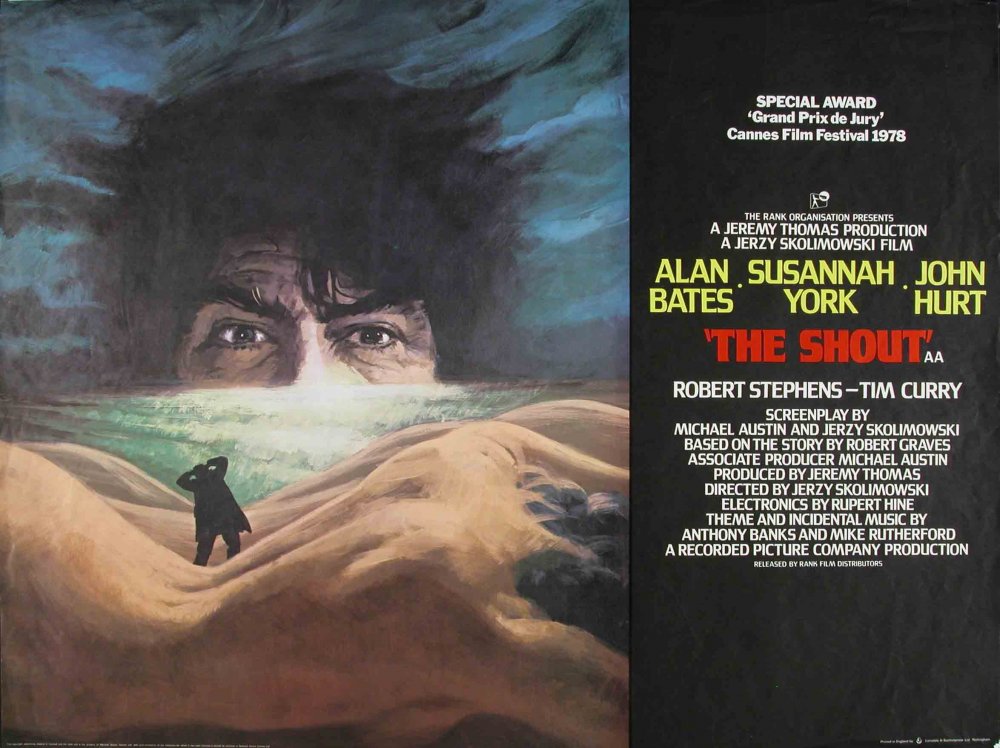
The Shout (Jerzy Skolimowski, 1978)


Polish director Jerzy Skolimowski brought a unique, outsider’s eye to the portrayal of Britain on film. He brilliantly faked much of London in Deep End (1970) while characterising the same city as an incredibly paranoid, almost dystopian zone in Moonlighting (1982).

Most effective of all, however, is the director’s strange and darkly magical portrayal of the English coastline in his 1978 film The Shout, which contains – among many other unique things – one of British cinema’s most unnerving examples of sound design.

Based on a story by Robert Graves, and innovatively scored by Tony Banks and Mike Rutherford from the prog-rock band Genesis, Skolimowski’s film was always set to be an unusual artefact. But the director’s use of sound, with the help of sound editor stalwart Alan Bell, is where the film’s effectiveness resides, creating an eerie and overwhelming filmic experience.

The Shout is told in flashback, starting from a cricket match in an asylum where two inmates are telling how one of them came to be there. The story then follows a village couple, Rachel (Susannah York) and Anthony (John Hurt), who are visited by a stranger called Crossley (Alan Bates). With Anthony being an avant-garde musician, he becomes curious about Crossley’s supposed skills in aboriginal magic and the power to perform a shout that can kill. The film develops into a power play where magical elements are used to seduce Rachel and gradually remove Anthony from the scenario, psychologically and physically.

The film’s most powerful sequence concerns Crossley’s demonstration of his death shout for Anthony out on the coastline’s sand dunes. The scene builds with a long, walked journey to a place secluded enough to safely show the effects of the phenomena.


The dunes are a mythical landscape in themselves. Saunton Sands was also, in fact, where Peter (David Niven) from Powell & Pressburger’s A Matter of Life and Death (1946) was seemingly reincarnated. So there’s already something unusual in the air, and Skolimowski films the journey to nowhere with an abstract style. The pair then stop and prepare for the shout. Anthony covers his ears in haste, but Crossley stops him. He must only do so once the shout has begun.

Slow-motion images are subtly inserted throughout, making time in the sequence seem dreamlike and extended, to the point where the manic moment of the shout comes as a shock. Crossley’s towering body fills the frame from a low angle before the director quickly cuts in close to his screaming mouth, aping the paintings of Francis Bacon that are seen and mimicked throughout the film.

The shout is then released, the effect impossibly loud. There is a disjoint between the quietude of the build-up and the cut, jolting the viewer off guard for a brief moment before it is too late and they are immersed in the scream.

On first viewing, the moment creates a guttural feeling due to the mixing and editing. Skolimowski unusually cuts again, this time to the bodies of sheep and their shepherd falling into the sand. The linear progression of the film is as delicate as the memory and sanity of the perspective from which it is told.

For the rest of The Shout, Crossley gains an even more menacing air because of this scene. Knowing that at any moment he could open his mouth and allow that screaming thump of a wail to begin once more renders him dangerous to both the characters and the viewer.

Anthony stumbles down the dunes in shock at the power of Crossley’s voice and rightly so as Skolimowski shows the brutal power of the sound. But, with the effect so precise and perfectly pitched, the viewer cannot help but stumble down the sand with him, sharing in a brief moment of oblivion. --BFI

Friday, May 15, 2020

The Old Dark House (James Whale, 1932)


Dudley-born director James Whale was the leading light of Universal’s iconic 1930s horror cycle. His work with the studio resulted in a handful of the genre’s most effective and memorable films, including Frankenstein (1931), The Invisible Man (1933) and Bride of Frankenstein (1935).

His sense of daring encapsulates the chutzpah of pre-Code Hollywood cinema, which regularly pushed the boundaries of what was acceptable to show on screen. It all ended when the Hays Code came in in 1934, leading to censorship of everything from violence and depictions of religious imagery to sexuality and nudity. But that was not before Whale had turned in his most taboo-laden picture: 1932’s The Old Dark House, which was brilliantly adapted from J.B. Priestley’s 1927 novel Benighted.

Three travellers, Penderel (Melvyn Douglas), Margaret (Gloria Stuart) and Philip (Raymond Massey), are driving through Wales on their way to Shrewsbury when they are forced off the road in a storm. They are given shelter in an isolated house by a strange pair of siblings, Rebecca and Horace Femm (Eva Moore and Ernest Thesiger), who live with their ancient father, Sir Roderick Femm (Elspeth Dudgeon), and their mute butler, Morgan (Boris Karloff).


The sheltering group are joined by two more travellers, Sir William Porterhouse (Charles Laughton) and his dancer girlfriend Gladys (Lilian Bond), who are also forced to take refuge from the storm. As the drama follows the exchanges and frictions between these differing characters, it becomes clear that something darker is hidden in the house. Someone dangerous is locked away in secret among the eerie corridors and stairways, soon to escape and cause mayhem.

Whale’s sense of horror often works because it’s balanced with dark humour or else sometimes personal explorations of identity. The Old Dark House is a vastly influential early example of the haunted house movie, containing premonitions of many of horror cinema’s go-to narrative clicks, including isolated groups, remote rural houses, mysterious inhabitants hiding secrets and even the ominous sound of whistling wind.

But it’s just as important for its very modern questioning of class, gender, sexuality and mental health. While it’s true that these are dealt with in ways that are perhaps too general or glib to be seen as genuinely progressive, the fact that they are tackled at all might seem surprising in a film of this vintage.

Sir William Porterhouse is quintessentially northern, of a type who would have been very familiar to Whale from his England days – and in many ways a precursor to Laughton’s Henry Hobson in the David Lean film Hobson’s Choice (1954). Of all the characters in the film, he’s the one we find out most about. At first he seems brash and overconfident, clearly a man used to getting his own way. His bullish attitude is explained later on during a story about the loss of his first wife, after public dismissal of her working-class clothing drove her to despair. His success was fuelled by his subsequent hatred of class snobbery, working successfully to earn more money than the people who had scorned him and his tragic bride.


Class isn’t the only aspect of everyday life channelled into The Old Dark House. The presence of Ernest Thesiger automatically provides a channel for Whale’s own persona, the actor being a clear cipher for the director’s homosexuality. This would be even more to the fore in Bride of Frankenstein, with Thesiger’s Doctor Pretorius being one of the earliest and most effective examples of cinematic camp. Here though, while bitchy and eye-rolling like a nervous Kenneth Williams, Thesiger’s Horace is far more nuanced, playing the gin-loving brother who is very much under the thumb of his more domineering sister.

Rebecca is the true head of the house, the traditional screen gender roles of this period being totally reversed. In one unusual scene, she chastises Margaret for her confident sexuality. It’s a moment that, again, Whale subverts, this time by suggesting both Rebecca’s obvious envy of those who enjoy “fleshly love” and her frustrated desire to succumb to Margaret’s glamorous allure herself.

Added to all this, of course, is the fact that their aged father is quite earnestly played by a woman: Elspeth Dudgeon, billed in the credits as ‘John Dudgeon’. Gender and sexuality are far from heteronormative in The Old Dark House.

Karloff’s character is the last aspect to investigate. The family’s secret, crazed brother, Saul (Brember Wills), is locked away due to his psychotic pyromania. Morgan the butler, however, is different. Whale never really tells the viewer about him other than how his behaviour gets out of control when he drinks. His lack of background makes him seem dangerous, but it’s Karloff’s physicality that produces the film’s more obvious elements of horror. He’s still playing the tragic figure in the mould of Frankenstein’s creature.

He is also the only character who appears to feel sadness at Saul’s ultimate demise. Perhaps he found solace in the madness of this other character, locked away and equally chastised by the family.

The questions surrounding mental and physical disability are ultimately left hanging here. Yet, by hinting at such issues of identity bubbling under, Whale’s film becomes much more than simply horrific entertainment. Between the floorboards of The Old Dark House, there is much more being discussed than at first appears. --BFI

Thursday, May 14, 2020

Vital (Shinya Tsukamoto, 2004)


After spending years covering the human body in scrap metal (in the Tetsuo films), bruises, wounds, and scars (in Tokyo Fist and Bullet Ballet), and dirt (in Gemini), Shinya Tsukamoto was finally comfortable enough to expose it in all its naked glory in A Snake of June. Asuka Kurosawa's liberation from emotional and physical repression while masturbating in the pouring rain took Tsukamoto on a new course. But with the skin as a seemingly obvious endpoint, it was a course that begged the question "Where to next?"

Continue in the same direction, is the logical yet surprising answer. With Vital he digs deeper, past the skin and into the body, his camera exploring our innermost like the modern-day equivalent to Leonardo DaVinci's sketchbook. Rest assured, though, for just as A Snake of June steered well clear of exploiting the topic of female sexuality, Vital wisely avoids lingering close-ups of quivering organs and bloodsoaked body cavities. Tsukamoto's goal is a much more philosophical one; his search is for our individual consciousness and where in our bodies we might find it.

Hiroshi (Asano, who previously worked with the director in Gemini) is a medical student plagued with amnesia after a road accident that took the life of his girlfriend Ryoko (newcomer Nami Tsukamoto, no relation). Settling back into his parents' concrete apartment with his mind a blank sheet, he sleepwalks through the days like a ghost. The discovery of an anatomy textbook rekindles memories of his devotion to his medical studies and as the recollections, particularly those of his girlfriend, slowly start to flow back, he decides to re-enter university and pick up where he left off. When the body on his class dissection table turns out to be that of Ryoko, Hiroshi starts a feverish search for their shared past, hoping to find what was lost by digging it up from inside her preserved corpse.


Up to this point, Tsukamoto's work, despite the popular conception of him as a sci-fi filmmaker, has always had a very strong social relevance. Dealing with the rediscovery of the feelings that were numbed by the drudging routine of urban life, his films have been chronicles of contemporary everyday existence. Essentially reworking this pattern from film to film in true auteurist sense, adding different nuances each time, he seemed to have come to the end of his quest with the aforementioned A Snake of June, which saw the first attempts at separating the motif of reawakening human feelings from the context of life in the city.

Vital affirms this conclusion. Here, for the first time, the director operates on a much more abstract level. Hiroshi regaining his memory and submerging himself in the bliss of his lost love still follows the same pattern as Tsukamoto's previous protagonists, but nearly all connections with the urban surroundings as a cause have been severed. To all intents and purposes, Vital shows us a Shinya Tsukamoto who is totally free, a filmmaker starting a new stage in his work - an artist reborn.

What this means for us as viewers is the great joy of watching a film of deep emotional resonance. Gone is the pounding, the metal hammer with which the director wanted to smash us over our skulls in his previous work. Tsukamoto always knew how to reach his audience deep inside, but instead of giving them a direct punch to the gut, with Vital he gradually fills them with a warmth that builds and builds as the film's 86 minutes pass. And he achieves it without surrendering an inch of his trademark intensity. Intense this time is not the noise, the machine-gun editing, or the violence, but the beauty. With Vital, Shinya Tsukamoto has made an intensely beautiful film. --Midnight Eye

Wednesday, May 13, 2020

The Housemaid (Kim Ki-young, 1960)


There has long been a tendency in film culture to think of the cinema of Third World countries as dominated by trite melodramas. In many ways, The Housemaid—made by Kim Ki-young in South Korea in 1960, when the country was still part of the developing world and reeling from brutal Japanese colonial occupation, a civil war, and extreme poverty—certainly fits the melodramatic mold: its story concerns a marital crisis (a staple of the genre) precipitated by the hiring of a new maid, and its emotions often run violently high. But it is far from the product of an underdeveloped cinematic sensibility; with its stylistic restraint and self-deprecating humor, it deviates from the excesses and self-seriousness commonly associated with melodrama, giving it an unyielding power. And it reaches beyond its glossy surfaces to question the validity of conservative family values and class divisions.

Kim Ki-young was born around 1920 in Seoul (in the south) but raised mainly in Pyongyang (in the north), before Korea was divided after World War II. After high school, Kim lived for some time in Japan, then earned a degree in otolaryngology at Seoul National University. During the Korean War, he served as an intern at a hospital in Busan, South Korea’s temporary capital, before accepting a job making newsreels for the U.S. embassy’s Cultural Affairs and Public Relations Department (producing anti-Communist propaganda for the United States paid a lot more than examining patients’ nostrils). He abandoned his medical career and, soon after the war, began making films. He produced eight features between 1955 and 1960 before The Housemaid, inspired by neorealism and using the documentary skills he’d picked up during the war.

Alongside the likes of Shin Sang-ok and Yi Man-hee, Kim led South Korean cinema’s charge during its golden age of the 1960s and early 1970s, a time when the nation’s film industry was so beloved by its people that the military government had trouble regulating it and it often got away with subversive themes. It was also one of the most active and profitable film industries in Asia at the time, producing at its peak (1968–71) over two hundred films per year. Despite the large and devoted audience at home, South Korean cinema of this era remained relatively unknown internationally, and it is still left unmentioned in most English-language world cinema histories.


Unlike some of his fellow golden age filmmakers, Kim had a sensibility that was often at odds with Korean aesthetic tradition, which is characterized by the thematic motifs of han (pent-up grief), pastoral mise-en-scènes, and understated, quasi-Buddhist emotions. Instead of sublimating han, Kim’s characters, as The Housemaid attests, plot revenge; instead of mountainous rural landscapes and thatched roofs, his films take place on overpopulated asphalt sidewalks, against neon lights, and in Western-style mansions hung with cubist paintings; and instead of Buddhist minimalism, he prefers Freudian desire. Kim, drawing mainly on funds from his wife’s successful dental practice, financed, wrote, directed, art directed, and edited many of his films, including his masterpiece, The Housemaid, which he made in his early forties. The first departure from the neorealist vein of his early films, it has, like so much great cinema, the ability to transmute visual and aural details into existential inquiries.

Kim uses a story-within-a-story structure to tell his tale of a maid (Lee Eun- shim) who is hired to help manage domestic affairs in the Kim household, where the wife and mother (Ju Jeung-nyeo) has fallen ill from overwork at her at-home job as a seamstress. The two-floor Western-style house the Kims and their two children have recently acquired is simply too big for Mrs. Kim to manage. But after the nameless maid allows herself to be seduced by Mr. Kim, she plunges the entire family into a wicked nightmare. The structure of The Housemaid blurs the division between reality and fiction, making for a hallucinatory experience. Much of the music is diegetic, the acting is subtle, and the revenge plot concocted by the angry maid, who seeks blood to avenge the loss of her child, is not overwhelmingly implausible, despite being rooted in melodrama. The constant movement of the camera, exquisite close-ups, meticulous framing of shadows, and occasional use of an at times cacophonous modernist score merit comparisons with the great German Kammerspielfilme (chamber dramas) of the twenties and early thirties. So limpid and nimble are the jokes, so sarcastic the caricature of the nuclear family, so plain the passions and desires that play across the surfaces of The Housemaid, that one might be tempted to think it was made in a society as liberal as Weimar Germany, not one usually governed by brutal dictatorships.

In the eighties and early nineties, Kim and other directors of his ilk were forgotten by the public, thanks to the popularity of television, the prolonged rule of military leaders who wanted films to serve their ideologies, and the removal of many of the trade restrictions placed on Hollywood films. But then in the mid to late nineties, a new generation of directors (many of whose names have become synonymous with the international South Korean cinema renaissance of the twenty-first century: Park Chan-wook, Ryu Seung-wan, Bong Joon-ho, Kim Jee-woon) brought another breath of fresh air to the national cinema. These young filmmakers, inspired by global cinema culture and drawn more to urban decay than provincial or traditional values, had discovered Kim’s movies at local thrift stores, used video shops, and second-run theaters, and no Korean filmmaker of a previous era appealed to them more. They found his vision uniquely grotesque, irrepressible, and rebellious, and they decided to help resuscitate his career, by holding retrospectives of his work, inviting him to sit on festival juries, and volunteering to assist on his next feature (which unfortunately never got made, because of his sudden, tragic death).


Though the original version of The Housemaid had not been released on VHS, because two of its reels had been lost, Kim’s own remakes of the film, Fire Woman (1971) and Fire Woman ’82 (1982), were available. The young filmmakers were so taken with the remakes that they were eager to see the original, and they got their wish in 1997. The recently inaugurated Busan International Film Festival held a Kim retrospective that year, with the two previously missing reels from The Housemaid recovered from a newly discovered release print (though with obnoxious English subtitles, as discussed below), and the young Korean filmmakers’ taste proved to be consistent with that of international art-house moviegoers. Retrospectives of Kim’s work became the vogue at many festivals and cinematheques around the world. Berlin, London, Belgrade, San Francisco, Hong Kong, Paris, and many other places honored this maverick filmmaker. He died a couple of days before he was scheduled to depart for Berlin to attend the first-ever retrospective of his work overseas in 1998. The cause of his death was a house fire set off by a short circuit—a bizarre ending even for a man whose vision was as uncanny as Kim’s.

Of the thirty-two feature films Kim made in the course of his career, only twenty-two survive intact. His first picture, Box of Death (1955), miraculously turned up at the Washington National Records Center in Maryland in 2011, without its sound reel, and a twenty-minute portion of Touch-Me-Not (1956) was recently recovered, but eight films still remain missing altogether. Despite the militancy of its government, South Korea didn’t actually participate in any wars during Kim’s career, which leads one to wonder what could account for the devastating loss of such a significant portion of an auteur’s body of work.

An unlikely joint effort on the part of hatmakers and chemists, driven by desperate postwar conditions that engendered a countrywide abhorrence of waste and an enterprising national mind-set, was responsible for the insuperable loss of not just those works of Kim’s but many films in South Korea. After owners of factories that manufactured a kind of straw hat popular among farmers realized that a strip of celluloid lent the headgear’s otherwise flimsy brim an extraordinary sturdiness and, at the same time, made for a stylish decorative border, they began to purchase apparently worthless, worn- out 16 mm and 35 mm prints in bulk, once the films had finished their dollar- theater runs. Many classic titles were chopped into thousands of pieces as they were moved on a conveyor belt from exhaustion to extinction. When the popularity of the straw hats dwindled in the 1970s because of a rapid decline in the farming population, innovative chemists developed a way to efficiently extract silver from celluloid film. More invaluable works evaporated in that alchemical process, causing irreversible damage to South Korean film history; over 70 percent of films made before 1960 are now reported missing. This frenzy for the reuse of celluloid meant that film preservation didn’t exist in the country before the 1990s.

Given this climate of total disregard for cultural heritage, it is amazing that The Housemaid did not end up being recycled as silverware or a sun shield. Because it was personally financed by Kim, his household kept the original negative. However, those two reels were still missing. Only in the early 1990s was a release print, which had been made for overseas film festivals, found in storage at the Korean Film Commission. The problem was that the print had burned-in English subtitles that had been hand-scribbled by Korean calligraphers at the time of its export in 1960, and the letters were inconsistent in size, though all enormous. Three-line subtitles sometimes covered more than a third of the frame. The placement of the subtitles also varied slightly from frame to frame, causing the dialogue to sometimes waltz a bit to the left or the right as the film rolled, which made for an unnecessarily dynamic viewing experience for those who had to negotiate both the moving camera and the dancing subtitles.

Where standard restoration processes focus on the removal of dust and scratches, flicker and grain reduction, and color grading, the task the Korean archivists faced was far more difficult, as they had to erase each stroke of the English lettering on every frame of two ten-minute segments. Even with the financial support provided by the World Cinema Project, the job proved to be impossible with existing resources. Complicating matters further, the restored film was scheduled to premiere at the 2008 Cannes Film Festival. It was then that the Korean Film Archive summoned timely assistance from computer scientists at Seoul National University’s Intelligent Signal Processing Laboratory, who teamed up with administrators at the Korea Creative Content Agency and technicians at the HFR-Digital Film Laboratory in Seoul to develop a software program that made the erasure of every trace of the subtitles possible just in time for the world premiere in May 2008.

Kim Ki-young defied both genre rules and social conventions by playfully crossing the borders between reality and fiction, social rules and personal cravings, and gluttony and self-restraint, helping Koreans suffering poverty and other postwar trauma forget their miseries. Now, the WCP and the KFA together have made that vision available for all of us who are left to savor it. --Criterion


Tuesday, May 12, 2020

Illustrious Corpses aka Cadaveri Eccellenti (Francesco Rosi, 1976)


Rosi calls Illustrious Corpses "a trip through the monsters and monstrosities of power." A detective thriller cast in the mold of a political exposé or vice-versa, it is the story of a mysterious killer (or killers) whose victims are judges, public prosecutors, and magistrates. The dogged, Marlowe-like detective who follows this morbid trail uncovers a nest of corruption at every cultural and political turn: every witness, indeed every institution in Italian society, has a stake in the collapse of the judiciary. Rosi's most despairing comment on absolute power and corruption is also his most stylistically distinguished. From the famous opening sequence in which the mummified magistrates sit upright in the catacombs, "Rosi shows such a majestic, ominous spatial sense in this movie that at times it seems to be an architectural fantasy about a country of the dead." (Pauline Kael) Lino Ventura as the melancholy detective is joined by a star cast including Fernando Rey and Max von Sydow --BAMPFA

Monday, May 11, 2020

A Bay of Blood aka Twitch of the Death Nerve (Mario Bava, 1971)


In their native Italy, they’re known affectionately as giallo. Cheap, paperback novels so named because of their lurid yellow covers, their pages were filled with mystery and murder. While the genre had existed in the pages of pulp fiction since the 30s, it was director Mario Bava who brought the sensationalist themes of giallo to the big screen with The Girl Who Knew Too Much (La Ragazza Che Sapeva Troppo) in 1962.

It was Bava, with his operatic direction filled with dramatic shadows and often drenched in colour, who established many of the trappings that would become familiar in giallo cinema. His heavily stylised camera work, expressive use of lighting and, above all, imaginatively brutal murders would have a profound, lasting impact on filmmaking, influencing such directors as Lucio Fulci and Dario Argento, who would go on to direct many classic gialli of their own.

Of all Bava’s gory epics, it was perhaps A Bay Of Blood (La Baie Sangliante) that would have the greatest impact on international cinema. Variously known elsewhere as Twitch Of The Death Nerve, or simply Carnage, A Bay Of Blood provides a clear bridge between the giallo murder mystery films of 60s and 70s Italian cinema, and the slasher movie genre that would hit US cinemas like an express train a few years after.


Inarguably the most graphically violent of any of Bava’s films, A Bay Of Blood‘s plot is torn straight from the pages of pulp mystery. In its opening scenes, an aged, wheelchair bound millionairess is brutally murdered by an unseen assailant who, in a nod to Hitchcock, remains immersed in shadow.

But then, just when we think we’re in familiar whodunnit territory, Bava confounds expectations in bravura style, first removing the killer’s anonymity, and then having him abruptly slain in a drizzle of lipstick-red gore.

It’s an opening scene that sets the tone for what is to follow, and Bava directs A Bay Of Blood with an expert surety and a macabre, midnight-black sense of humour.

A Bay Of Blood introduces each of its characters in turn, and every one is uniquely despicable. Among them there’s conniving real estate agent, Frank (Chris Avram), monosyllabic fisherman Simon (Claudio Volonté), entomologist Paolo (Leopoldo Trieste) and his scolding, fortune telling wife, Anna (Laura Betti, who spends much of the film fluttering around in a shawl like Kate Bush).

Almost every character has some claim to the titular bay, and are prepared to commit murder in an attempt to inherit the late millionairess’ land.

What follows is an occasionally jaw dropping procession of killing after killing, each more imaginative than the last. Even after some 40 years of slasher movies and increasingly obscene violence, the gleeful imagination of Bava’s death scenes still hasn’t lost its edge.

There’s a stunning machete in the face, more than one impalement by spear, some throttlings (one of which is surprisingly harsh) and a beheading by axe. In every instance, there’s a definite impression, as the camera revels in every strike of a blade or fountain of blood, that Bava is treating these scenes as a kind of visceral fireworks display, and in each instance there’s a distant air of mischief and grim comedy.

Early on, four unbearably smug teenagers show up in an open top car. They have no relevance to the film’s plot, and appear only for Bava to chop them up in a series of elaborate set pieces, which he does, of course. And when the murders are over, Bava cuts back to the open top car beside the bay, its chrome fender bent into a sardonic, rictus grin.

It’s this section of the film, with its horny teenagers and bloody murders, that undoubtedly influenced Sean S. Cunningham’s Friday The 13th, and it’s highly likely the young director would have seen A Bay Of Blood in one of its grindhouse or drive-in showings in the 70s. Quite apart from sharing the same premise (teenagers slaughtered next to a stretch of water), two killings in Friday The 13th Part 2 are almost identical to those in Bava’s classic.

In fairness, the influence of A Bay Of Blood can be seen in numerous US slasher movies of the late 70s and 80s, from the prowling camera work of Halloween, which appears to have its genesis in Bava’s sometimes stunning cinematography, to its graphic scenes of creative violence, which have echoed down the years in films such as The Burning, Scream, and I Know What You Did Last Summer.

What many of those lesser imitators lacked, however, was Bava’s flair for black comedy and, in most cases, his unfailing eye for startling images. The latter is illustrated in the unforgettable sequence of an octopus slithering across the face of a corpse, while the former can be seen most obviously in A Bay Of Blood‘s shocking and genuinely funny climax, which could be regarded as one of the most glorious rug pulls in cinema, or a wry comment on the corrupting nature of violence. However you react to that final sequence, it’s unlikely to be forgotten in a hurry.

A Bay Of Blood was a pivotal movie in screen horror, perhaps as important, in its own way, as Hitchcock’s highly regarded Psycho. Bava’s film marked the moment where giallo cinema tipped over into slasher horror, with A Bay Of Blood‘s murder mystery plotline taking a back seat to another, equally entertaining diversion: who was going to die next, and how gruesome would that death be?

The influence of Bava’s movie on US filmmakers is undeniable, and its status as one of Italian cinema’s horror classics is assured. Almost four decades on, A Bay Of Blood remains a hilarious, messy masterpiece. --DOG

Sunday, May 10, 2020

Burn! aka Queimada - the KG Hybrid Cut (Gillo Pontecorvo, 1969)


Gillo Pontecorvo’s best known film, Battle of Algiers, may be set in French-occupied Algeria, and the characters sure enough speak French (and Arabic), but the film remains the absolute apotheosis of Italian Neo-Realism. Shot amidst the daily life on the streets of the Kasbah on grainy low-contrast 16mm film with a consistently hand-held camera and featuring amateurs in starring roles, Battle proved so convincingly Neo-Realist that it features an on-screen disclaimer asserting that no documentary footage appears in the film. Adding to the realist air is Pontecorvo’s refusal to take a moral position; the torturing French paratroopers and bomb-toting, café-obliterating Algerian housewives are all one to him. He’s depicting a struggle, showing us the historical wheel as it turns, and his dispassion (though he’s kinda rooting for the Algerians) makes Battle timeless in a way that more overt agit-prop could never be.

It’s also the most prescient, accurate, and detailed film ever made on anti-colonial insurgency. We all know the Pentagon screened the film last year in Iraq. The question is why? It certainly couldn’t have cheered them up. Pontecorvo’s insights are tough and, as history has demonstrated, irrefutable: 1) Insurgency turns to terrorism to make up for its lack of a formally trained and equipped army. 2) The colonialist power is forced to match its opponent in barbarity—kidnappings, torture, state-sanctioned murder—to have any chance of holding on. 3) As a result, the colonial power pays a moral cost that likely outweighs any tactical/political benefits. And 4) eventually, no matter what, the insurgency prevails.

These conclusions set the context for Pontecorvo’s next film, Burn!

Battle of Algiers deals with the outcome of hundreds of years of colonial oppression. Burn!, set in the 1840s Caribbean, addresses the roots. Like Battle, Burn! (originally titled: Queimada) is a tragedy of historical and personal inevitability. Once again, Pontecorvo makes his loyalties (barely) known, but stands back to let the wheel turn. With an odd calm, he presents one atrocity after another. Some are physical, some moral, some emotional. Each, however horrible, is presented as the inevitable collision of entrenched culture and the new paradigm arriving, either via the barrel of a gun or thanks to someone’s pernicious self-interest (or, you know, both). Yet Pontecorvo remains a teacher, not a preacher. Burn! hews to the Neo-Realist aesthetic: show the world as it is, let the audience sort it out.

The screenplay offers two men as incarnations of irreconcilable historical forces. Marlon Brando plays William Walker, an English intelligence agent sent to a Portuguese-controlled Caribbean island to foment a native revolution. His revolution’s goal is to displace the Portuguese monopoly and turn the island into a British trading zone. Once he convinces the former and current slaves that such a revolution is possible, however, they develop goals of their own.


Pontecorvo nails the hard truths. Burn! is a quietly bleak, unflinching presentation of slavery, post-slavery racial hatreds, the role of race in political power and the colonial manipulation of all of the above. Pontecorvo takes on these themes so clearly and directly—while keeping them secondary to the drama of the narrative—that Burn! becomes a lesson in how few other films ever address them at all.

The island is known as Queimada ("burnt" in Portuguese) because the Portuguese set it on fire it to quell an indigenous rebellion. Having thus killed off all the native inhabitants, they imported African slaves to work their cane fields. In the opening sequence, we see a small glaringly white off-shore key—a dumping ground for the bodies of slaves who died on the voyage from Africa. With purely visual storytelling, Pontecorvo sets the scene: everything on the island that pretends to be progress is built on the bones of dead slaves. (The original screenplay cast the island and its overlords as Spanish. But the producers objected, citing the size of the potential Spanish market and the certain banning of the picture. The Portuguese, a much smaller audience all told, were shoved into the villains’ role.)

Playing a charismatic, illiterate cane-cutter—whom Brando incites to lead the revolution—is Evaristo Márquez, a charismatic, illiterate cane-cutter whom Pontecorvo found in Columbia, where most of the film was shot. Promotional materials insist that not only had Márquez never acted in a film, he had never seen one. Brando lost his shit about three-quarters of the way through production—fed up with Pontecorvo shooting a million takes while surreptitiously whispering to and poking Márquez to guide him through his scenes—and fled Colombia. Pontecorvo ended up shooting in more luxurious locations, chosen to Brando’s liking.

Anyway, Márquez can’t exactly act. Like Brando, he’s portraying a symbolic figure of history in the form of a character, and that’s tough duty. Brando brings more subtlety to the task, of course. Yet Márquez comes off as wholly believable as a cane-cutter, a revolutionary, a general, and a martyr. He yields nothing to Brando as a character or an on-screen force. Early in the picture we have to grant him some slack, but he’s not the only reason we have to be generous.

This version orginale—this uncut original print—is dubbed in Italian, as almost all Italian movies were. The dubbing proves a gift and a curse. A gift because this print has a richer, more detailed narrative and an epic sensibility absent in the butchered English-language version. But a curse because it splits the storytelling into two perceptual spheres.

The first, more enveloping sphere contains the lush, self-consciously gorgeous cinematography and the sophisticated visual narrative that needs no dialogue. The less convincing sphere features the scenes dependent upon the spoken word. Márquez’s dubbing seems less intrusive, maybe because we don’t know what he sounds like. But every time Brando’s mouth moves and Italian emerges, we’re hurled—and I mean hurled—out of the story and back into the awareness of sitting in a theatre watching a movie and wishing Brando would speak Inglese.

Especially because Brando wears this role as easily as the fawn-colored cut-away he sports in the final sequence. The guy loved playing upper-class (but tough-ass) fops: Fletcher Christian in Mutiny on the Bounty and Lt. Christian Diestl, a Wehrmacht officer with a conscience in The Young Lions, are the forerunners of his performance. Brando’s moves are so effete, and his vocal shadings (in the shitty U.S. version) so subtle. In one key scene he speaks to a black soldier who’s helping track down Brando’s former pupil Márquez (Brando’s creation of a determined revolutionary has succeeded far too well). As long as Márquez is alive and a fugitive, the soldier tells Brando, "I have work to do and good pay. Is it not the same for you?"

And Brando says, with the perfect insouciant self-loathing of precisely the upper-class British self-betrayer he portrays, "No, on the contrary; I work for an overall sum." And the wit of that moment is lost when an Italian stranger’s voice emerges from Brando’s pie-hole. It’s sadly distracting.

In another distracting moment, you might also find yourself noticing how well Brando rides a horse. It’s tricky placing Brando at this point in his career . He’s fat but not that fat. He’s self-indulgent but still capable. It’s shocking to re-discover how much grace Brando once possessed, and how physical his performances could be.


Visually, Pontecorvo abandons the scruffy conventions of Neo-Realism, and how. Opening with a montage of psychedelic blood-spattered images over one of Ennio Morricone’s weirdest, most exhilarating songs—a deranged amalgam of 1969 Euro electronic space-jazz and soaring African chant—the film self-consciously pursues beauty for its own sake. Using dense color-saturated film, the camera lingers over lush Caribbean vegetation as it does over unspeakable slums and Graham Greene-like tropical brothels (circa 1840s). Pontecorvo’s camerawork in Battle is austere and understated; here it’s full of movement and experimentation.

Pontecorvo’s clearly enthralled with the landscape and the vibrancy of the colors. For him they’re metaphors for the seduction of the island and the life-force of its (non-European) inhabitants. He’s also seduced by sensual, dangerous moments of pure physicality: African dances, voodoo funerals, urban riots, Brando helping push a corpse-laden hand-cart past a field of indifferent workers. Where Battle replicated reality, Burn! is a movie-movie and revels in its over-the-top style. Often that style induces rapture, but sometimes the movie-ness takes over the story, leaving us in it but not of it.

For all his ruthless political insight, Pontecorvo’s no Eisenstein. He edits with restraint and a minimum of cuts. Most shots—save the usual back-and-forth in conversation—are self-contained narratives, stories in themselves. He sets a scene and then zooms or pans to the punch line. Early on, we see the bloody dead bodies of Portuguese soldiers lying in the dust. Pontecorvo pans slowly from the corpses to a mob of ragged fugitive former slaves smiling wildly and dancing joyously with their rifles held high. They’re dancing because they’ve discovered, after 200 years of slavery, that white men die as easily as black. Or, more pointedly, that African slaves can kill Europeans. And—payback being a what?—that knowledge brings ecstasy.

Prescient and germane ain’t the half of it. Vietnam was raging when Burn! was made. And there are moments clearly designed to evoke that war. The British fire endless cannon into an apparently empty and indifferent jungle. Black soldiers hunt their own kind in service to the white colonial bosses. The revolutionaries suffer incredible privation but come out fighting. With Vietnam long gone, these images of a war of culture and of race, of old orders overturned and of Western bafflement in the face of murderous hatred, offer up a new, but hardly unfamiliar, set of references. Others might say the story is "torn from today’s headlines." I’d say it predicts tomorrow’s. And has for the last 35 years. --The Brooklyn Rail